How AI in Dentistry Helped Me Solve a Complex Implant Case
If you work long enough in dentistry, at some point you will encounter complications — both from your own work and from the work of other practitioners. That is simply part of clinical life.
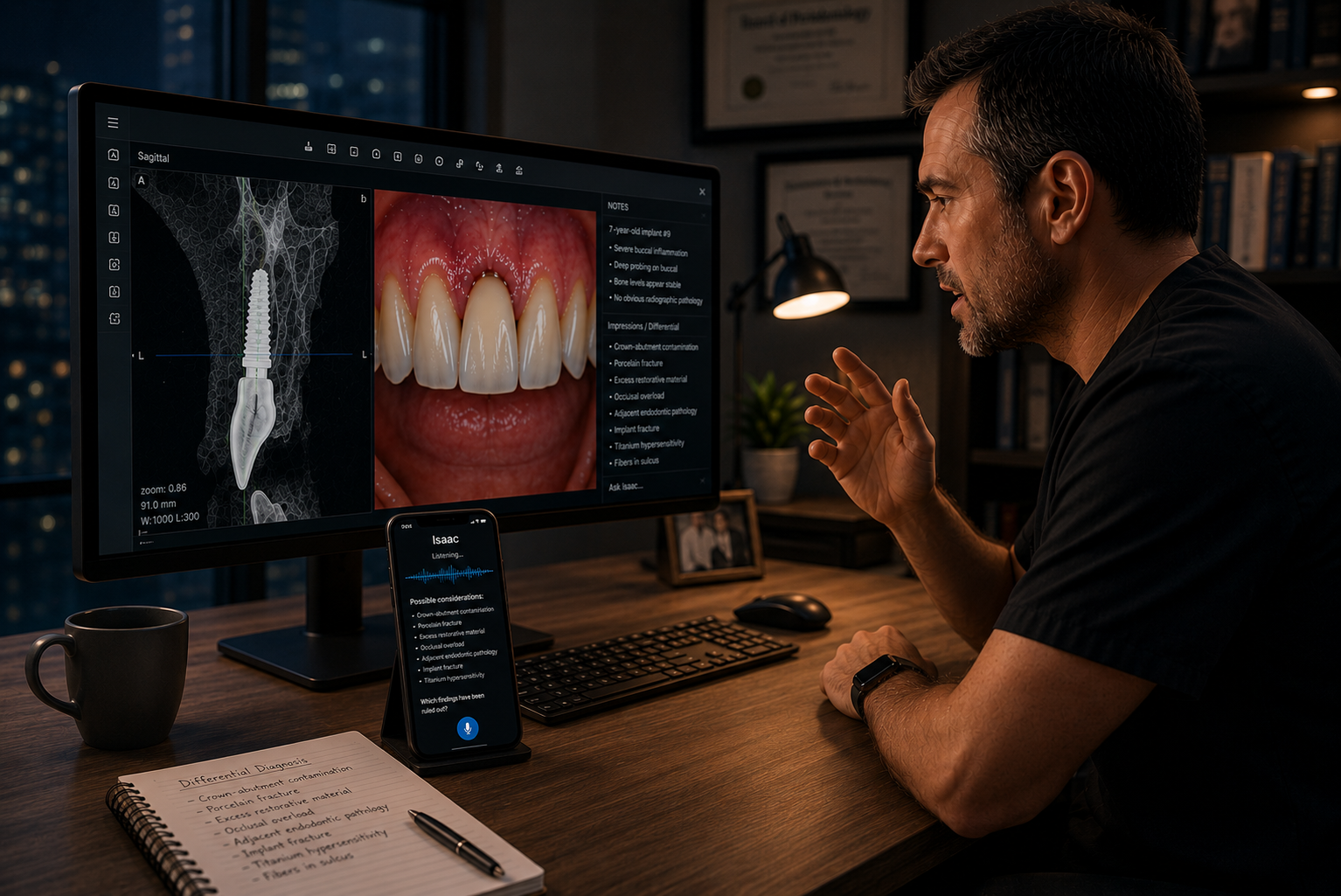
This week, I saw a patient for an emergency appointment related to a dental implant I had placed about seven years ago to replace a maxillary central incisor. She presented with intense peri-implant inflammation, particularly in the buccal gingiva, causing significant discomfort.
Before seeing me again, she had already consulted another practitioner. He had rinsed the area with chlorhexidine and prescribed systemic antibiotics — yet despite this, the problem persisted.
Clinically, the situation was nuanced.
The Clinical Case: Peri-Implant Inflammation With No Clear Cause
The crown was screw-retained. There was deep probing on the buccal aspect. Yet radiographically, bone levels looked stable and surprisingly normal. The inflammatory response appeared to be primarily within the soft tissue.
As the second clinician assessing the case, I could already learn from what had been attempted — but I was still left with difficult diagnostic questions to answer quickly and efficiently.
This was an emergency patient squeezed in between scheduled appointments. Every additional minute spent risked creating a cascade of delays for the rest of the day.
Fortunately, I had Isaac to guide me through the multiple possible scenarios and how to navigate each one without wasting precious time.
Using AI to Work Through the Differential Diagnosis
I began by running through the most obvious possibilities, using Isaac to investigate each scenario step by step.
Was there an issue with the crown-implant interface? Crown design? Fenestration of the buccal plate? Could it be the result of an endodontic infection in the adjacent endo-treated lateral incisor?
The CBCT allowed me to eliminate some possibilities — but the answer still wasn't entirely clear.
At that point, I asked Isaac to map additional differential diagnoses and prosthetically driven complications that could present this way. As a periodontist, I was slightly outside my comfort zone once the case started leaning more toward restorative and prosthetic considerations.
Isaac suggested several possibilities that hadn't spontaneously come to mind under pressure:
- Roughness at the crown-abutment interface
- Porcelain fracture creating plaque-retentive areas
- Tissue irritation related to subgingival restorative materials
- Incorrect tissue depth selection
- Fibers lodged in the sulcus
- Localized titanium hypersensitivity
- Implant collar complications
- Occlusal loading exacerbating inflammation
- Potential implant fracture
From Diagnostic Overload to Structured Clinical Reasoning
The cognitive relief of not having to carry every diagnostic pathway alone — under time pressure — was palpable.
As I progressively excluded the options, crown removal became the next logical step.
And there it was: a chunk of calculus lodged within the crown-abutment interface, along with a small porcelain fracture creating a rough, plaque-retentive surface.
The moment I saw it, my whole body relaxed.
The area was thoroughly cleaned and polished. However, the roughness at the crown-abutment margin will likely require future crown replacement to prevent recurrence.
I continued discussing the case with Isaac, using it as an opportunity to deepen the learning further — exploring what management would have looked like had the crown been cement-retained rather than screw-retained, including possibilities such as microflap debridement, crown removal, or replacement.
What could have become an increasingly stressful afternoon of uncertainty and delayed appointments instead became a valuable learning experience with a relatively conservative solution.
The Outcome
The patient returned one week later, and the soft tissues already looked significantly healthier.
Three months on: no pocketing, bleeding, or suppuration.
Cases like this remind me that native AI in dentistry is about supporting the clinician during moments of complexity, uncertainty, cognitive overload, and time pressure — not replacing clinical judgment, but sharpening it.
About the Author
Dr. Shervin Molayem is Chief Innovation Officer and Co-Founder of Trust AI. A periodontist and AI pioneer with 15 years of clinical experience, he filed the first patent in dental multimodal AI and introduced the first AI-powered periodontal probe (LuminX). He was among the first researchers globally to establish the Mouth-COVID connection and serves on the Innovation Committee at DAIA (Dental AI International Association). His work advances oral-systemic health through evidence-based technology.
Related Articles
Malpractice Prevention Should Be Designed Into the Practice

AI is Changing What Makes a Dental Practice Valuable