
AI Tech Stack for Solo Dentists: How to Choose the Right Dental AI Tools
Artificial intelligence has moved from the edges of dentistry to its center. What once felt like experimental tools for scribing or imaging has evolved into a landscape of automated receptionists, communication platforms, insurance engines, diagnostic models, and treatment-planning systems. For solo practitioners, the question is no longer whether to adopt AI in dentistry. The real question is no longer whether to adopt AI in dentistry or which dental AI tools to choose—it's how to create an integrated, efficient tech stack instead of creating digital clutter.
Because the biggest threat to progress is not AI itself.
It is fragmentation.
You can invest in the best dental AI scribe, the best radiograph analyzer, the best communication system, or the best insurance verification engine—and still end up with a stressful, inefficient workflow if none of them talk to each other. Dentistry has entered a new technological era, but many practices are unknowingly building outdated, disjointed tech stacks that compete with each other rather than support each other.
This guide helps you build a unified, intelligent ecosystem that simplifies your day, strengthens your team, and meaningfully lowers overhead.
The current state of affairs:
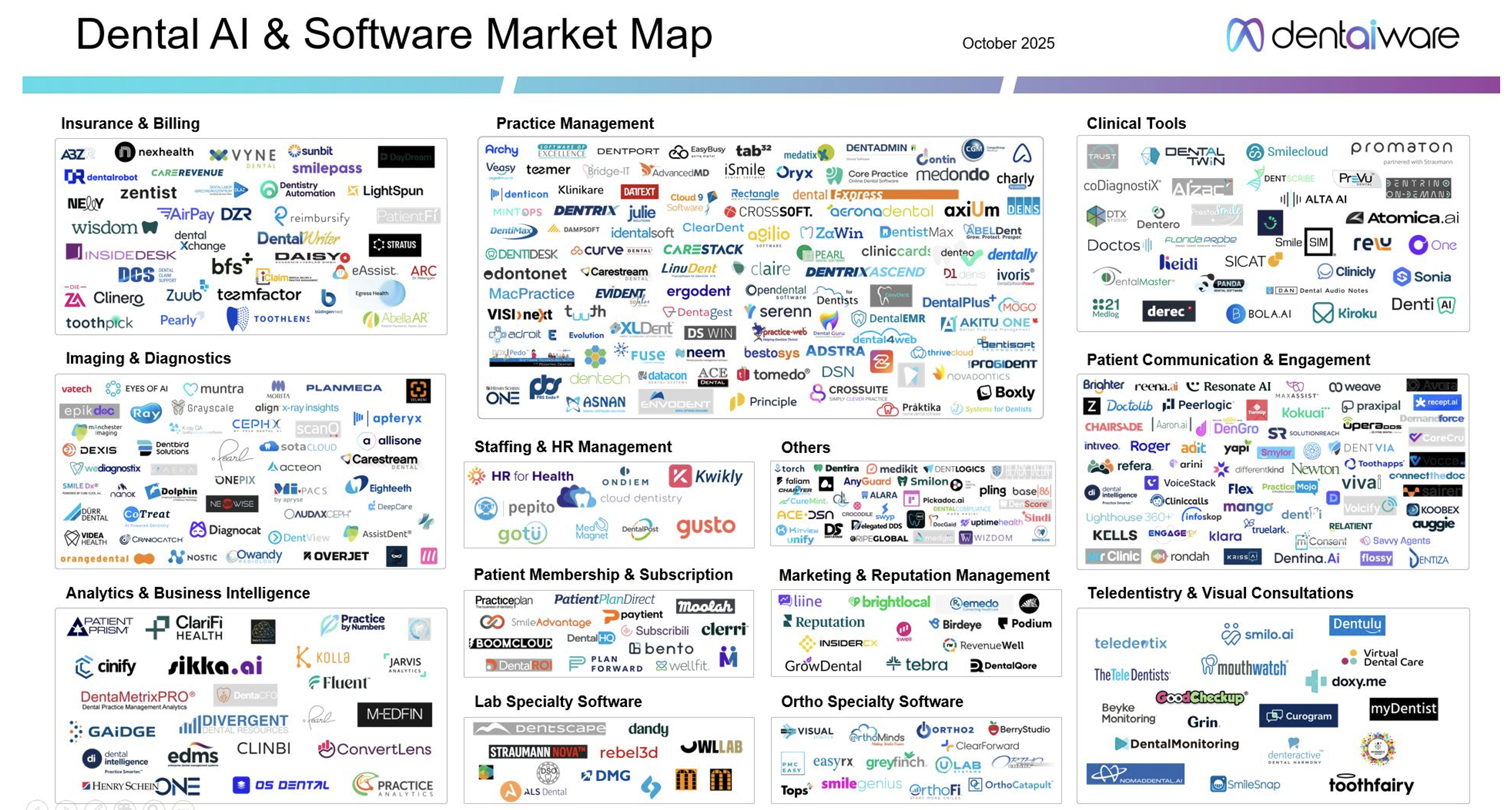
Start With Your Real Practice Problems Before Choosing any technology
Many dentists adopt AI reactively. A colleague praises a scribe. A conference speaker highlights an imaging tool. Someone online swears by a communication platform. These suggestions can be helpful, but reacting to individual tools leads to clutter rather than transformation.
The smarter starting point is to understand where your practice genuinely struggles. Where do your days slow down? What tasks drain your team's energy? Where does communication break down? What frustrates you during charting or treatment planning? Once you identify your true pain points, you can choose dental technology that actually solves them.
Understanding Which AI Tools Replace Work vs. Add More Work
AI adoption only works when it reduces workload. Some tools genuinely replace manual tasks: they automate documentation, streamline communication, support diagnosis, verify insurance, or assist with treatment planning. These solutions give you time back.
Others simply add steps. They require more clicks, more switching, more double entry, and more mental effort. They create the appearance of progress while producing the opposite effect.
If a radiograph analyzer cannot speak to your dental AI scribe, it adds steps.
If your communication system cannot reflect diagnostic decisions, it adds steps.
If your scribe cannot reference clinical findings, it adds steps.
If AI does not reduce your daily workload, it is not replacing anything—it is simply another layer you must manage.
The Integration Trap: PMS Compatibility Is Not Real Integration
Most AI vendors promise compatibility with your practice management software. Many dentists assume this means the tools will work together.
But PMS integration only allows a basic push-and-pull of information. It does not mean your AI systems communicate with one another in real time.
A scribe may document a clinical finding but remain blind to what your imaging AI identifies. An imaging tool may push a screenshot into the PMS but offer no connection to treatment planning. A communication platform may schedule reminders but have no understanding of clinical notes or diagnostic outcomes. An insurance system may verify benefits while remaining completely disconnected from diagnostics.
This is how dentists end up with multiple logins, multiple dashboards, multiple subscriptions, and zero unified workflow.
Pearl, Denti.AI, Heidi, Lassie and Weave all perform exceptionally well in their individual categories—but they are still point solutions. Each solves one problem in isolation. When your tools do not communicate with each other, the promise of AI becomes diluted.
Why the Future of Dentistry Belongs to Unified AI Ecosystems
The future of dentistry will not be powered by ten different AI apps stitched together with hope. It will be powered by one connected, intelligent ecosystem that acts as the central nervous system of the practice.
In a unified system, your notes, diagnostics, imaging, treatment planning, communication, insurance workflows, and scheduling all feed each other seamlessly. Information flows naturally instead of being copied, re-typed, dragged, or re-uploaded.
This is precisely what Trust AI was built to deliver.
Trust AI does not aim to be one product among many. It was created to be the ecosystem itself.
While Pearl focuses on radiograph analysis, Dentina on reception duties, Heidi on scribing, and Weave on communications, Trust AI unifies these categories into a single platform where every component speaks the same language. Diagnostics inform notes. Notes inform communication. Communication informs insurance. Insurance informs scheduling. Everything updates in real time.
This is the difference between owning tools and owning infrastructure.
Customization: The System Should Fit You, Not the Other Way Around
A unified platform becomes even more powerful when it adapts to you. Dentists need customization—the ability to personalize note styles, adjust treatment plan templates, modify communication tone, and tailor workflows for each member of the team. Trust AI prioritizes this adaptability so that efficiency feels natural and aligned with how you prefer to practice.
The Financial Advantage of Symbiotic Technology: Lower Costs, Less Overhead, More Time
Overhead in dentistry is often associated with salaries, rent, labs, and supplies. But the most expensive overhead is invisible: time.
Every login, file upload, system switch, double entry, drag and drop, and repeated task quietly drains hours from your team each week. Fragmented tools create a constant tax on your day, and this tax compounds.
When systems do not talk to each other, your overhead rises. When everything communicates natively, overhead falls significantly.
In a unified system, there is no double entry.
- No screen switching.
- No re-typing.
- No re-uploading.
- No searching across multiple platforms.
- No conflicting sources of information.
You reclaim hours each week, reduce team burnout, and move from the typical 70 percent overhead toward 60 percent or better—not by cutting staff or compromising care but by eliminating wasted time. Replacing five or six separate subscriptions with one unified platform adds direct financial savings, but the real transformation comes from the regained time that compounds every day.
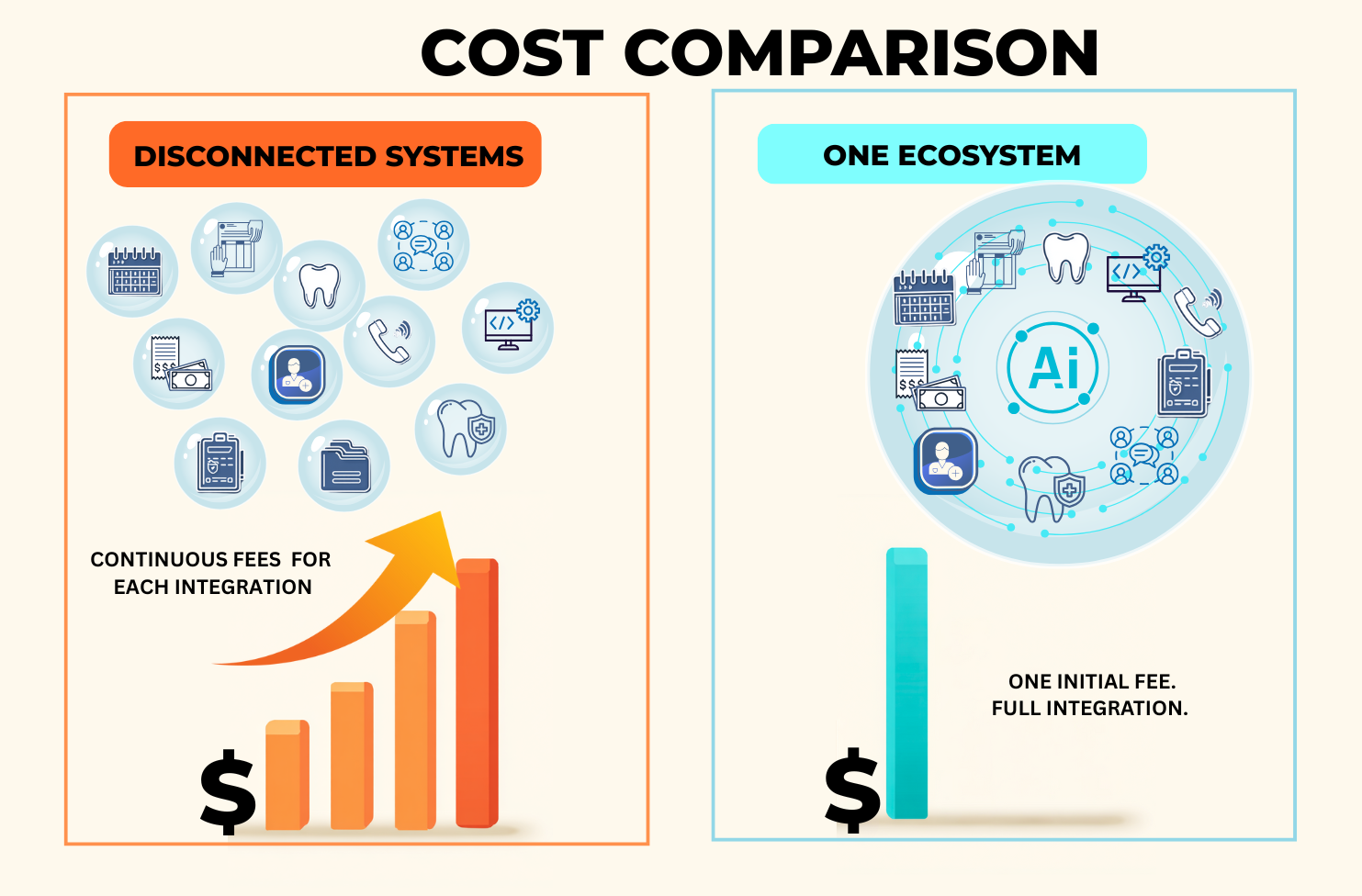
A Modern Approach to AI Adoption: Unified, Simple, and At Your Pace
You are practicing in a rare moment in dental history. In the past, adopting new technology meant trialing one software at a time, stacking point solutions, and hoping they played well together. Each tool came with its own learning curve, contract, support team, and interruptions to your practice.
Only Trust AI gives you the ability to adopt AI at your pace while keeping every part of your workflow under one connected roof.
You can start with charting, imaging, insurance, communication, or treatment planning—and expand naturally without introducing new systems or navigating new dashboards. Everything you need is already in one place. As your comfort grows, the platform unlocks deeper capabilities without disruption or additional subscriptions.
Our mission was never to become part of the ecosystem.
Our mission was to be the ecosystem.
And that single decision changes everything.
It eliminates fragmentation, preserves efficiency, and creates a practice that runs with you—not against you.
The Final Question Every Solo Practitioner Must Ask About Dental Integration
Dentistry is advancing quickly. The practices that will thrive are not the ones collecting the most tools. They are the ones building the most integration.
So ask yourself:
Am I constructing a modern AI-powered practice, or am I assembling disconnected apps that will eventually slow me down?
Your future efficiency, financial stability, and clinical consistency depend on this answer.
And for the first time, dentistry has a platform capable of giving you a unified, integrated, intelligent foundation.
Modern dentistry does not need more tools.
It needs intelligence at the core.
Isaac PracticeOS unifies scheduling, documentation, insurance, and insight into one connected system.
About the Author
Dr. Divian Narendra Patel, DDS, BDS
Chief Clinical Officer, Co-Founder
Dr. Patel practices at San Ramon Dental Excellence in California, specializing in conservative, ethical dentistry. His expertise spans invisible orthodontics, restorative, cosmetic, and implant dentistry, with a focus on delivering healthy, functional, and aesthetically pleasing results that prioritize patient well-being. He is the Chief Clinical Officer and co-founder of Trust AI.
Related Articles
Malpractice Prevention Should Be Designed Into the Practice

AI is Changing What Makes a Dental Practice Valuable