
From 1-Star Reviews to 5-Star Growth: How AI Transforms Dental Practice Management
When a One-Star Review Becomes Your Practice's Greatest Teacher
Every dentist has felt it: that jolt when a one-star review appears.
It stings not because of vanity, but because dentistry is personal. You remember the face, the procedure, the conversation that didn't go as planned. Before long, you're replaying it in your mind asking, What went wrong?
Maybe it was:
- A patient upset about cost or insurance confusion
- A crown that came off too soon
- A front-desk miscommunication that left someone feeling dismissed
According to recent data, 94% of dental patients read online reviews before choosing a provider, and a single negative review can deter up to 30 potential patients. These moments can feel defeating, but what if they're actually data points waiting to be understood?
From Emotion to Insight: How AI Reframes Feedback
The emotional side of dentistry is real. We care deeply, and that's what makes negative feedback hurt. But AI for dental practices introduces something powerful into that equation: perspective.
When you have systems that can see patterns across time, procedures, and people, patient feedback stops feeling like personal criticism and starts becoming clinical intelligence.
Imagine AI dental practice management software quietly running in the background, surfacing patterns like:
Clinical Trends:
"Post-op sensitivity after composite restorations increased 8% this quarter—primarily with Brand X materials on posterior teeth."
Operational Flags:
"Patients waiting over 15 minutes have a 40% higher chance of leaving negative reviews. Your 2-3pm time slot averages 22-minute delays."
Communication Insights:
"Patients who asked more than two follow-up questions during financial discussions showed 35% lower treatment acceptance and higher post-visit dissatisfaction."
AI doesn't replace you; it refocuses you. It turns reactive pain into proactive precision.
From Self-Blame to Systems Thinking
When that one-star review hits, our instinct is self-blame. We think, "I failed that patient."
But AI for dentists teaches us something different: most negative reviews aren't about you; they're about the system.
A late insurance claim. A scheduling glitch. A tone that didn't translate well. All small, human things amplified by perception and timing.
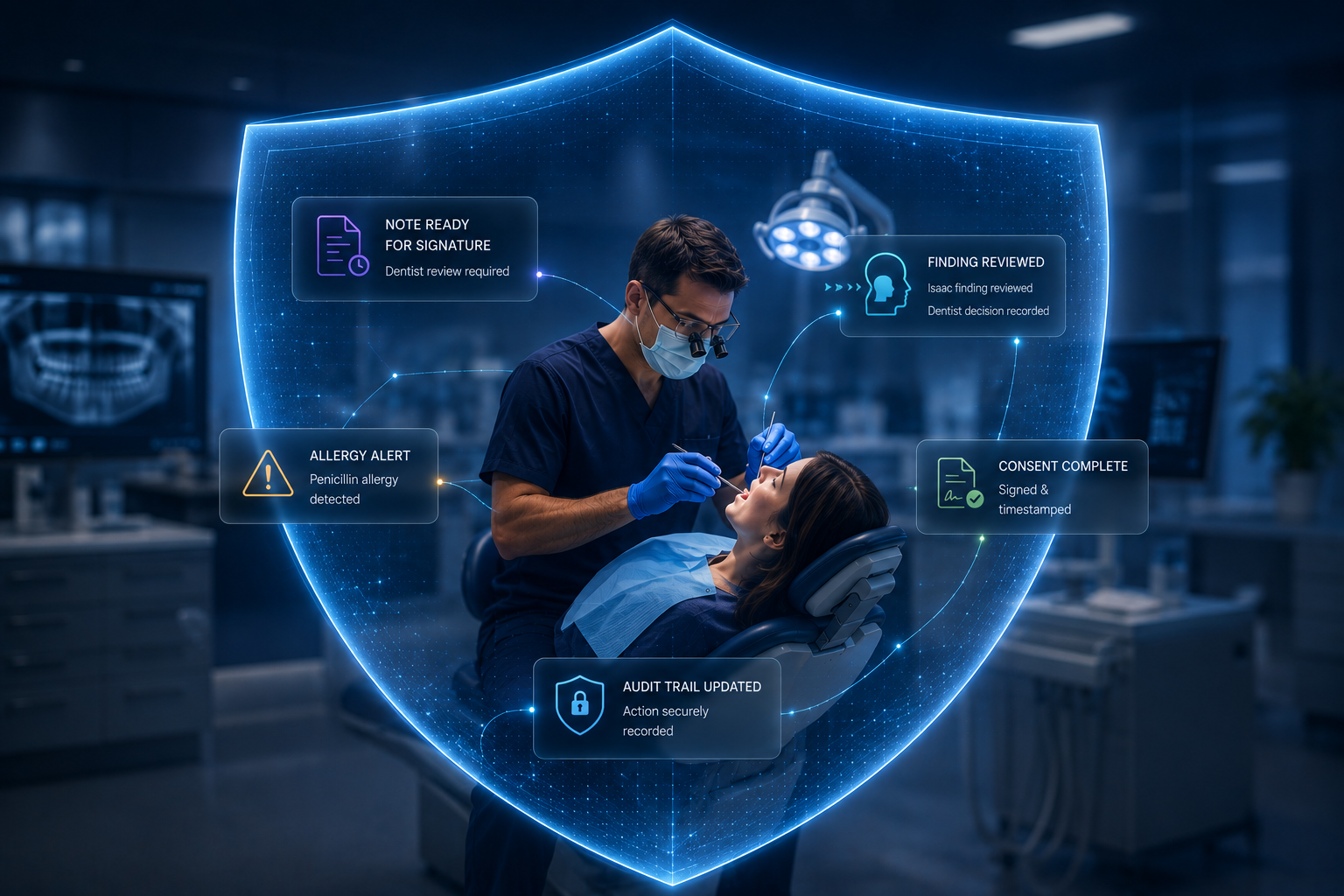
With an AI co-pilot like Isaac from Trust AI, these signals don't slip through the cracks.
Isaac correlates:
- Clinical outcomes with communication patterns
- Treatment plans with acceptance likelihoods
- Front-desk interactions with patient sentiment scores
That's how dental practice management moves from reactive to predictive.
Seeing Patterns Where You Once Saw Problems
A negative review is no longer a blow to your confidence; it's a data trigger. The AI-enhanced practice focuses on learning loops, not emotional spirals.
| Emotion-Driven Reaction | AI-Driven Reflection |
|---|---|
| "They didn't like me." | "Was their frustration linked to wait time or financial clarity?" |
| "This crown failure ruined my reputation." | "How many similar cases did we have? What variables repeated across failures?" |
| "The front desk made us look bad." | "Are peak-hour calls being missed or rushed? What's our response time data?" |
Over time, you stop asking "Why did this happen to me?" and start asking "What is this telling me about my system?"
Real-World Impact: When AI Reveals What Manual Tracking Misses
Dr. Sarah Chen's practice in Austin noticed something troubling: post-op sensitivity complaints jumped from 3% to 11% over two months. Manually, this would take weeks to investigate.
Isaac flagged the pattern in 18 days.
The dental AI software identified that 87% of complaints involved posterior composite restorations—all using a new material introduced that quarter. The brand performed poorly on molars with deep preparations, while no other variables (technique, curing time, patient age) correlated.
Result: Dr. Chen switched back to her previous material for deep posterior restorations. Within 45 days, sensitivity complaints dropped to 2.8%—below her original baseline.
This is the power of AI-powered dental practice management: turning scattered complaints into actionable clinical intelligence.
The Hidden Curriculum of Leadership
Every critical review exposes a blind spot. AI for dental practices turns those blind spots into opportunities to lead.
If your dental AI software shows peri-implantitis recurrence is higher than your specialty's benchmark, that's not failure—that's empowerment. Now you can review maintenance protocols, adjust hygiene recall intervals, and monitor improvements with real-time dashboards.
AI helps you separate signals from noise, transforming patient feedback analysis into a framework for continuous improvement.
The Emotional Intelligence of AI: Clarity Through Data
AI doesn't erase emotion; it clarifies it.
Instead of losing sleep over a single scathing comment, you gain perspective:
"This was a 1% anomaly in 1,247 patient interactions this year. Our overall satisfaction score is 4.7/5.0, and 94% of patients would recommend us."
That's emotional freedom through data.
AI dental practice management honors the human side of dentistry by giving clarity to chaos. When emotion meets analytics, you make decisions that are smarter and kinder—to your patients, your team, and yourself.
The Future of Dentistry: Data Empathy in Action
The next decade of dental practice management will be defined not by technology alone, but by data empathy—the ability to blend compassion with insight.
A dentist empowered by AI doesn't crumble under criticism. They course-correct with confidence.
When your dental AI software shows that:
- Hygiene recall rates dipped 12% after a policy change
- Treatment acceptance rose 23% when you simplified financial explanations
- Same-day emergency slots reduced negative reviews by 31%
You realize: Feedback isn't something that happens TO you; it's something that happens FOR you.
That's how AI transforms one-star moments into five-star growth.
The Takeaway: Your AI Co-Pilot for Practice Growth
A one-star review is not your story's end; it's your system's mirror.
When AI sits beside you—interpreting trends across patients, teams, and time—your entire outlook changes. With a co-pilot like Isaac, you don't just fix what went wrong.
- You understand WHY it happened.
- You prevent it from happening again.
- You build systems that make negative reviews rare.
That's how good practices become great—through precision, not perfection.
Reflective Question
If your practice had an AI co-pilot that could flag early signs of recurring complications or patient friction, what would you want it to focus on first?
Clinical outcomes? Patient experience? Team communication?
The future of dentistry isn't about avoiding one-star reviews—it's about building systems that make them rare.
About the Author
Dr. Divian Narendra Patel, DDS, BDS
Chief Clinical Officer, Co-Founder
Dr. Patel practices at San Ramon Dental Excellence in California, specializing in conservative, ethical dentistry. His expertise spans invisible orthodontics, restorative, cosmetic, and implant dentistry, with a focus on delivering healthy, functional, and aesthetically pleasing results that prioritize patient well-being. He is the Chief Clinical Officer and co-founder of Trust AI.
Related Articles
Malpractice Prevention Should Be Designed Into the Practice

AI is Changing What Makes a Dental Practice Valuable