Malpractice Prevention Should Be Designed Into the Practice
For decades, dentistry has approached malpractice prevention largely as a matter of professional vigilance.
Document carefully. Obtain informed consent. Review the medical history. Check medications and allergies. Follow up with patients. Keep complete records.
All of these things are essential.
But there is an inherent weakness in this model: it depends on people remembering to do everything, every time.
And many situations that later become malpractice problems don't necessarily begin with a bad clinical decision. They can begin with something much smaller: an incomplete note, missing consent, an allergy that wasn't surfaced, a patient who needed treatment but was lost to follow-up, or a clinical decision whose history cannot be clearly reconstructed later.
These aren't only documentation problems. They are operational problems.
What malpractice cases can teach us
This was an important theme in our Voices of Dental AI conversations with Dr. Steven Feit, a prosthodontist and expert witness who has spent years examining dental malpractice cases.
Our conversations explored the patterns that can lead to malpractice situations, including documentation failures, breakdowns within the practice, and how AI and better systems can move risk management from reactive to proactive.
Listen to our malpractice conversations with Dr. Steven Feit
It raises an important question:
What if malpractice prevention didn't begin after something went wrong? What if it was designed into the way the practice operates?
The old way: record what happened
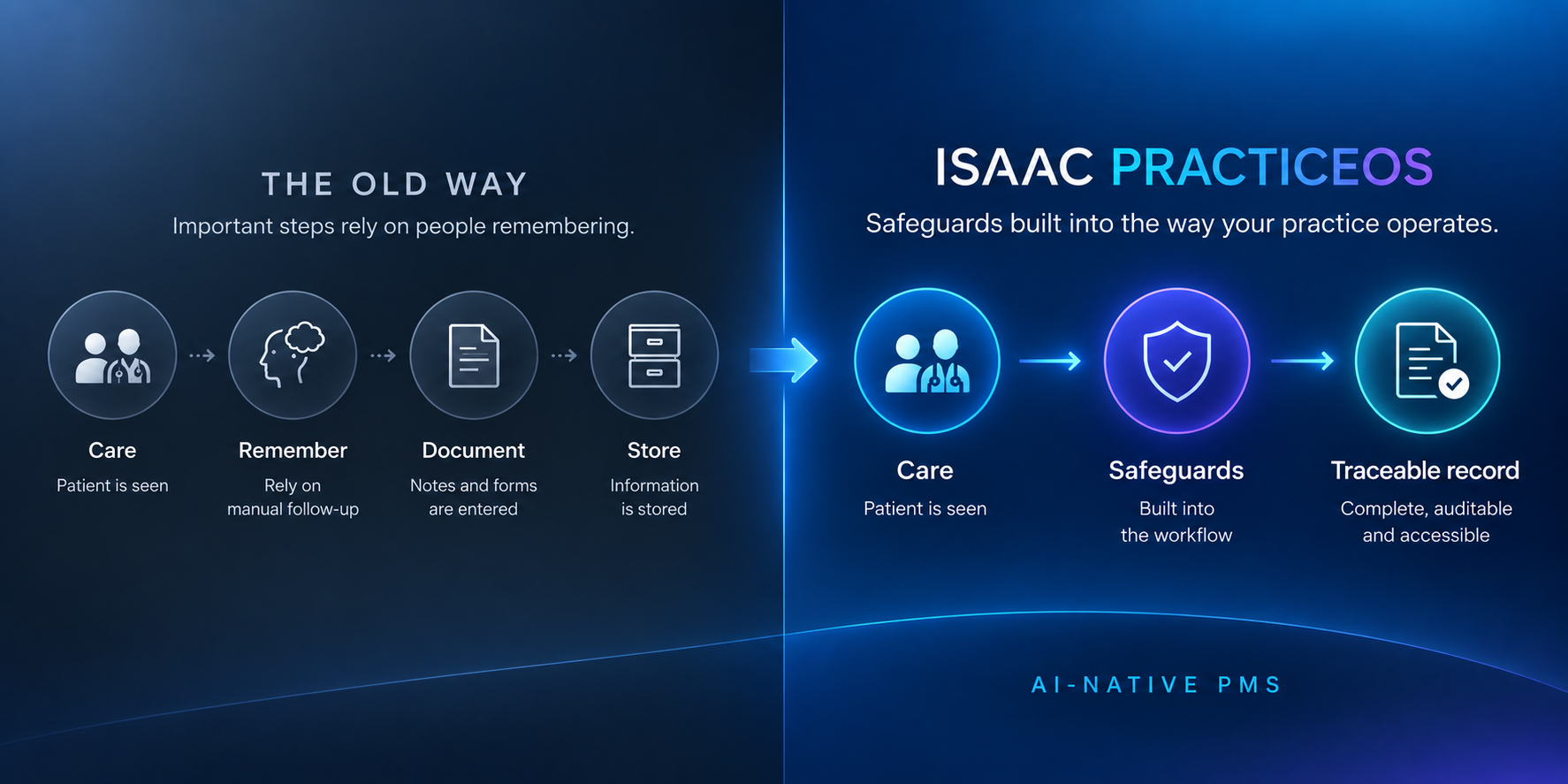
Traditional practice-management systems were largely built to record information.
A patient was seen. Someone entered the note.
Consent was obtained. Someone stored the form.
A patient needed to return. Someone was expected to follow up.
The system stored what the practice gave it. But many of the safeguards surrounding patient care still depended on office protocols, checklists and human memory. The system recorded the work. It didn't participate in making sure important steps weren't missed.
That is one of the fundamental changes we set out to make with Isaac PracticeOS.
Building safeguards into the way the practice operates
Isaac PracticeOS doesn't have a single "malpractice module."
Instead, safeguards are built across the workflows where risk can develop.
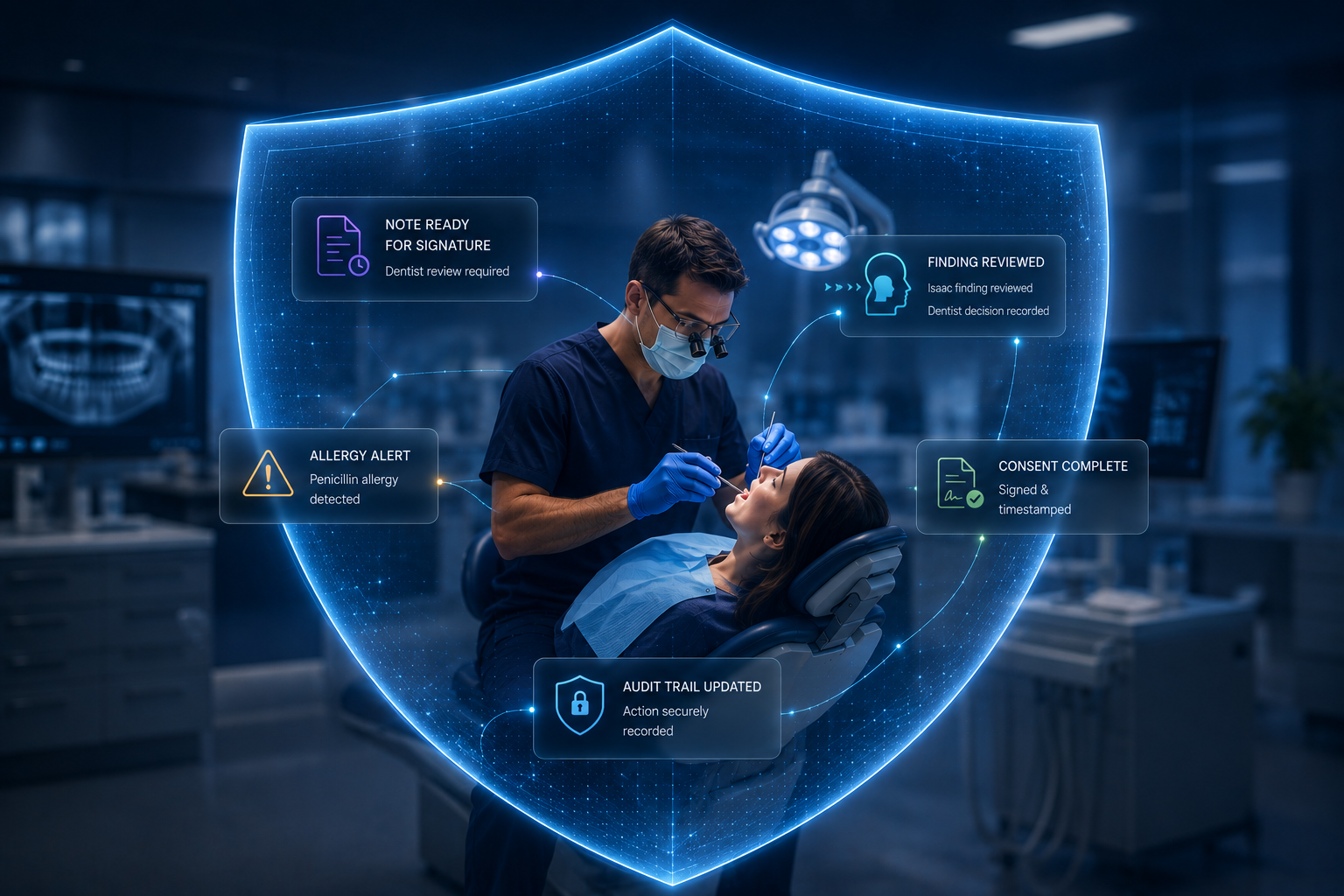
Take clinical documentation. Isaac's AI Scribe helps capture the visit and create the clinical note, but the note still goes through a sign-and-attest workflow. Non-dentists cannot finalize a note without a dentist co-signature. After 72 hours, the note locks for editing. Any later change requires a formal addendum with a reason, while edits made before the lock are versioned with who changed what and when.
That creates a very different record from one that can simply be edited later without a clear history.
The same principle applies to informed consent. Isaac PracticeOS has consent templates that can be linked to specific procedures. Booking a procedure can automatically dispatch the appropriate consent form, with reminders and multi-channel delivery. Both the sent and signed PDFs are retained with timestamps. Financial consent is separately captured through treatment-plan and estimate signatures.
Patient safety information is surfaced where it matters. Allergies, antibiotic premedication requirements and do-not-schedule flags appear on the schedule and appointment details. Prescribing includes drug-allergy and drug-drug interaction checks. Medical-history refreshes are tracked so the practice can establish whether the history was current at the time of treatment.
And Isaac helps close another important operational gap: follow-up. When a patient leaves without a future appointment, the system can detect that open loop and track the outreach attempt through to resolution.
Don't rely solely on someone remembering every safeguard. Build more of those safeguards into how the practice operates.
Isaac assists. The dentist decides.
There is another dimension to malpractice risk that becomes increasingly important as AI enters dentistry: accountability for AI-assisted clinical decisions.
Our position is clear. Isaac is assistive, never authoritative. The dentist remains the clinical decision-maker.
X-ray analysis is presented for the dentist to evaluate and decide. When a dentist edits an Isaac finding, both the original finding and the dentist's edit are retained.
Treatment plans generated by Isaac are validated against the patient's actual chart using 56 validation rules, so Isaac cannot assert a finding the chart doesn't support.
And Isaac's critical clinical actions are logged in an append-only audit trail.
The objective isn't to replace clinical accountability with AI.
It is to make accountability more traceable.
What information was available? What did Isaac identify? What did the dentist conclude? What was documented? Was consent captured? Was follow-up required? Did it happen? Was something subsequently changed?
A modern practice should be better able to answer those questions from the record itself.
From documenting the practice to protecting the process
No technology can eliminate malpractice. Dentistry will always require clinical judgment, communication and professional responsibility.
But we can build better systems around the people providing that care.
The old model largely depended on dentists and their teams remembering the safeguards and documenting what happened.
An AI-native operating system gives us the opportunity to build more of those safeguards directly into the operation of the practice.
That is an important part of what we are building with Isaac PracticeOS.
Not AI that takes responsibility away from the dentist.
Not AI that makes the final clinical decision.
But an intelligent operating system designed to help make sure that documentation, consent, patient safety, follow-up and accountability don't quietly fall through the cracks.
Because malpractice prevention shouldn't begin when an attorney asks for the chart.
It should begin with how the practice operates every day.
See how Isaac PracticeOS builds safeguards into the way your practice operates:
Related Articles

AI is Changing What Makes a Dental Practice Valuable

Fifteen Minutes to Prepare: How Isaac Helped Me Face a Child's Dental Emergency