
Dental Procedures Covered by Medical Insurance: Bypass the $1,500 Cap
Here's a number that should make you uneasy: $1,500.
That's the annual maximum on most dental insurance plans. It was $1,000 in 1970. Adjusted for inflation, that would be over $8,000 today. Instead, we got a 50% bump over five decades.
Meanwhile, the cost of a single implant can run $3,000 to $6,000. A full-mouth reconstruction? $60,000 or more. The math doesn't work. Patients defer treatment. Practices lose revenue. Everyone loses.
But here's what most dentists don't realize: medical insurance covers many dental procedures with no annual maximum. Unlike dental plans capped at $1,500, medical insurance pays for dental work when it's medically necessary.
The Medical Insurance 'Loophole' for Dental Procedures
Medical insurance will pay for dental procedures when they're deemed "medically necessary." This isn't a loophole. It's not fraud. It's exactly how the system is designed to work.
The key phrase is "inextricably linked"—when dental treatment is connected to a medical condition or the success of a medical procedure, it crosses from dental territory into medical territory. And medical insurance pays differently. Better.
Think about it from the insurer's perspective. Dental insurance is built around prevention and maintenance—cleanings, fillings, the routine stuff. Medical insurance is built to handle serious health conditions. When a dental issue becomes a medical issue, the coverage follows.
The challenge is that most dental schools don't teach this. Most practice management software doesn't support it. And most front office teams have never filed a medical claim. So the opportunity sits there, unused.
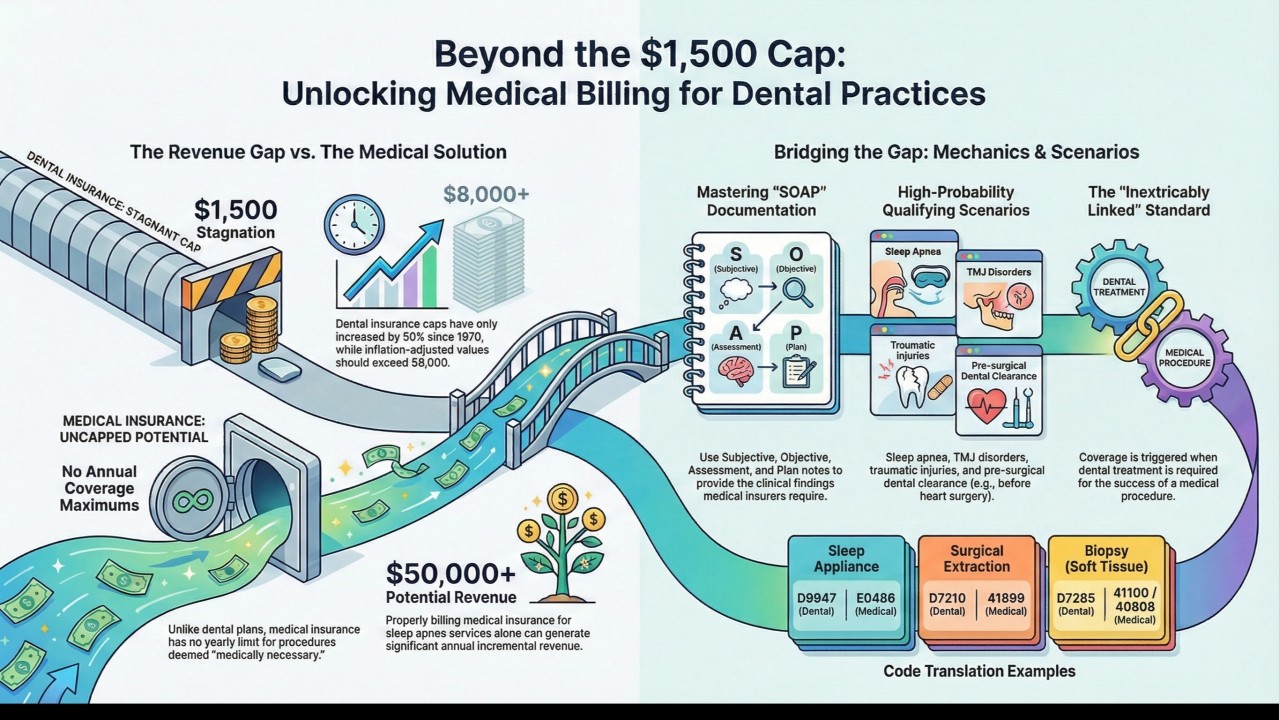
Unlocking Medical Billing for Dental Practices
What Dental Procedures Actually Qualify for Medical Insurance
Let's get specific. These are the dental procedures that medical insurance routinely covers when properly documented and billed.
Sleep Apnea Oral Appliances
This is the easiest win in medical billing for dentists. Obstructive sleep apnea is a medical condition. Oral appliance therapy is a recognized treatment covered by medical insurance. The coding is straightforward: one ICD-10 diagnosis code (G47.33), one CPT procedure code (E0486).
Average reimbursement: $1,700 to $2,500 per case.
The requirements are clear. You need a sleep study diagnosis from a physician—either a polysomnogram or a home sleep test. You need a prescription or referral. And for severe cases, you typically need documentation that the patient tried and failed CPAP therapy.
Dental insurance pays nothing for sleep appliances. Medical insurance covers them routinely. If you're not offering this service, you're leaving money on the table and patients undertreated.
TMJ and Temporomandibular Disorder Treatment
When Temporomandibular Disorder (TMD) causes documented pain, functional impairment, headaches, or facial myalgia, it becomes a medical condition covered by medical insurance. Splints and therapy can be billed to medical insurance when you establish the medical necessity.
The documentation matters here. You need clinical findings, not just patient complaints. Range of motion measurements. Palpation results. Imaging when appropriate. The SOAP note format (Subjective, Objective, Assessment, Plan) is your friend. A little tip: sign up for our AI Scribe to generate free SOAP Notes.
Traumatic Dental Injuries
This one is intuitive. A patient gets hit in the face during a car accident or takes an elbow during a basketball game. The resulting dental work isn't routine dental care—it's trauma treatment covered by medical insurance.
Medical insurance covers the full scope: emergency stabilization, extractions, root canals, implants, prosthetics, and reconstructive work. The key is documenting the mechanism of injury and establishing that the treatment restores function lost due to trauma.
Note: if there's auto insurance or liability coverage involved, you bill that first. Medical insurance comes after.
Pre-Surgical Dental Clearance
Here's where things get interesting, especially with recent Medicare changes.
When a patient needs dental work before a major medical procedure—and that dental work is required for the medical procedure to succeed—medical insurance covers it. The clinical term is that the dental service is "inextricably linked to the clinical success" of the medical treatment.
Current qualifying scenarios include:
- •Organ transplants (including bone marrow and stem cell)
- •Cardiac valve replacement or repair
- •Head and neck cancer treatment
- •Chemotherapy and radiation therapy
- •CAR-T cell therapy
- •High-dose bisphosphonate therapy for cancer
- •Dialysis for end-stage renal disease (new in 2025)
The dental exam, necessary x-rays, extractions of infected teeth, treatment of periodontal disease—all potentially covered under medical insurance when tied to these procedures.
Oral Pathology and Biopsy Procedures
Biopsies are diagnostic procedures covered by medical insurance. When you're evaluating a suspicious lesion for potential malignancy, you're practicing medicine. The CPT codes exist (41100, 40808, and others depending on location), and medical insurance recognizes these as covered services.
Surgical Extractions and Dental Implants
Complex extractions—impacted wisdom teeth, teeth removed due to infection or disease, extractions performed under general anesthesia—often qualify for medical billing. The determining factor is whether the procedure addresses a medical condition or requires medical-level intervention.
Dental implants are trickier. Routine tooth replacement is dental. But implants placed after trauma, cancer treatment, or when necessary to address documented functional impairment (malnutrition, inability to wear dentures, chronic pain) can qualify as medically necessary dental procedures covered by medical insurance.
The Mechanics: How to Bill Medical Insurance for Dental Work
Medical billing uses different codes than dental billing. You're translating from CDT (dental codes) to CPT (medical procedure codes), and you need ICD-10 diagnosis codes to establish medical necessity.
Cracking the Code: CPT vs CDT for Medical Billing
When billing medical insurance for dental procedures, you must use CPT codes instead of the CDT codes used for dental insurance. Here's how the translation works:
- →Sleep apnea appliance: E0486 (CPT) instead of D5999 (CDT)
- →TMJ splint: E1399 or 21089 (CPT) instead of D7880 (CDT)
- →Oral biopsy: 41100, 40808 (CPT) instead of D7286 (CDT)
You also need ICD-10 diagnosis codes to establish why the dental procedure is medically necessary.
Documentation That Gets Paid: What Medical Insurers Want
Medical insurers are stricter than dental insurers. They want to see:
- ✓Clinical findings: Objective measurements, not just symptoms
- ✓Medical necessity: Why this treatment is required for the patient's health
- ✓Care coordination: Evidence that medical and dental providers communicated
- ✓Supporting studies: Sleep tests, imaging, lab work as appropriate
The SOAP note format structures this well. Subjective (what the patient reports), Objective (what you observe and measure), Assessment (your diagnosis), Plan (your treatment approach).
Filing Medical Claims: The CMS-1500 Process
Medical claims go on CMS-1500 forms, not ADA dental claim forms. You'll need the patient's medical insurance information, which most dental practices don't routinely collect.
Some practices handle this in-house. Others partner with medical billing services that specialize in dental-to-medical cross-coding. The learning curve is real, but the revenue potential justifies the investment.
The Network Question: In or Out for Medical Claims?
Here's something that trips people up: your dental PPO network status doesn't carry over to medical insurance. You're essentially out-of-network for medical claims unless you specifically credential with medical payers.
The good news? Many medical insurers will still pay out-of-network providers, often at reasonable rates. Some will even extend "in-network courtesy" if you request it. And for procedures like sleep appliances, you can become a DME (Durable Medical Equipment) supplier with Medicare, which opens that entire patient population.
The 2025 Medicare Moment: New Dental Coverage Rules
Medicare has historically excluded dental coverage. That's changing slowly, but meaningfully.
Starting in 2025, CMS requires the KX modifier on dental claims to certify that services are "inextricably linked" to covered medical procedures. They've also expanded the list of qualifying scenarios to include dialysis patients.
Here's what's now explicitly covered under Medicare Part A and B:
- •Dental exams and treatment before organ transplants
- •Dental clearance before cardiac valve procedures
- •Treatment for oral complications of head and neck cancer
- •Dental care connected to chemotherapy, radiation, and cell therapies
- •Dental services for dialysis patients (new this year)
For dentists willing to enroll as Medicare providers and learn the documentation requirements, this opens access to 67 million beneficiaries who previously had no coverage pathway for these services.
The Revenue Math: What Medical Billing Means for Your Practice
Let's be concrete about what this means financially for dental procedures covered by medical insurance.
A practice that adds sleep apnea services and bills medical insurance properly can generate $20,000 to $50,000 or more annually from a modest caseload. That's pure incremental revenue from patients who would otherwise get no treatment.
For oral surgery and implant practices, medical billing on qualifying cases can mean the difference between a patient accepting a $30,000 treatment plan or walking away because their dental insurance covers $1,500.
The time investment is real. You need training, documentation systems, and either staff capability or outsourced support for medical claims. But practices that make this transition report that it pays for itself quickly, often within the first few cases.
The Catch: Challenges in Dental Medical Billing
I won't pretend this is easy.
Medical billing requires learning new code sets, new documentation standards, and new claim submission processes. Denials are more common than with dental claims, at least initially. You'll need to build appeals processes and persistence.
The compliance requirements are stricter. Medical insurers audit more aggressively. Your documentation needs to be bulletproof.
And some procedures will never qualify. Routine cleanings, standard fillings, cosmetic work, most orthodontics—these remain firmly in dental territory. Medical billing isn't a replacement for dental insurance; it's a complement for qualifying cases.
But here's the thing: your patients are already paying for medical insurance. Many of them are deferring dental treatment they need because their dental coverage falls short. You have the clinical skills to help them. The only missing piece is the billing knowledge to get paid for it.
Another tip: Medical billing will be embedded in Trust AI's flagship product Isaac PracticeOS; we'll be doing the hard work for you.
Where to Start: Medical Billing in Your Dental Practice
If you're new to billing medical insurance for dental procedures, start with sleep apnea. The pathway is well-established, the coding is straightforward, and the reimbursement is consistent. Build your documentation habits and claim submission processes on cases that have clear protocols.
From there, expand to TMD cases with strong medical necessity documentation. Then trauma cases as they present. Then surgical cases that qualify.
The resources exist. The American Dental Coders Association offers certification programs. Nierman Practice Management and others provide software and training specifically for dental-to-medical billing. The ADA has guidance on Medicare enrollment.
The question isn't whether medical billing works. It does. Thousands of practices do it successfully. The question is whether you're willing to invest in learning a new system or invest in a new AI-native PMS to capture revenue you're currently leaving behind.
Your patients have medical insurance. Many dental procedures are covered when properly documented and billed. It's time to capitalize on it.
About the Author
Dr. Bernard Casse, PhD, CEO of Trust AI, is the visionary behind Isaac and Isaac PracticeOS—the clinical intelligence platform helping dentists move into the future with greater trust, efficiency, and confidence. A leader in AI and robotics, he previously founded two VC-backed companies in Silicon Valley and has secured $100M+ in capital over the years, driving healthcare innovation through advanced technology.
Related Articles

Malpractice Prevention Should Be Designed Into the Practice

AI is Changing What Makes a Dental Practice Valuable