How the Dental Industry Became a Dr. Seuss Musical Instrument
A thought inspired by Dr. John Flucke, former Chief Dental Editor and Technology Editor at Dental Products Report.
The Moment the Analogy Landed
About a year and a half ago, my co-founder, Bernard D. Casse, and I attended the VIP dental technology meeting in Chicago. During one of the sessions, someone asked Dr. John Flucke what he thought the future of dentistry would look like.
As John Flucke described his vision, Bernard and I looked at each other and smiled.
By that point, our team had already spent a great deal of time thinking about multimodal AI treatment planning and how software could bring together all the information that influences a treatment decision. Radiographs, CBCT scans, intraoral photos, periodontal charting, medical history, clinical notes, and other patient data all tell part of the story.
When that information is viewed together, the dentist can develop a much clearer understanding of the complete clinical picture.
John was describing a future that sounded remarkably similar to the one we had been working toward. That moment stayed with me.
A few months later, my other co-founder, Dr. Divian Narendra Patel, and I had a Zoom call with John to show him what we were building. During the conversation, he made a comparison that I have thought about many times since.
The Dr. Seuss Instrument
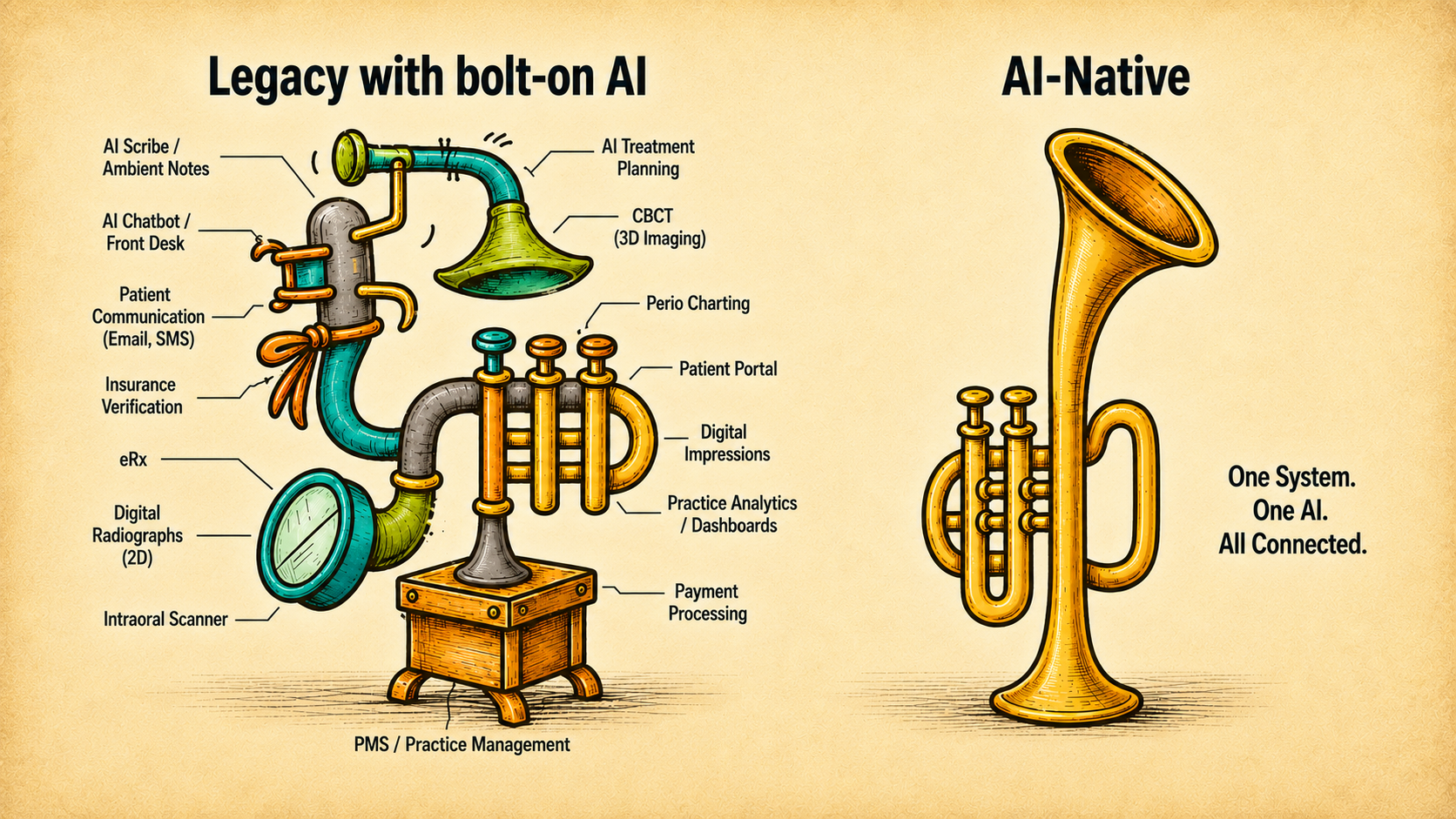
He said the dental industry had become like one of those bizarre Dr. Seuss musical instruments.
You know the ones. Pipes going in every direction. Horns sticking out at odd angles. Levers, buttons, pedals, gears, and moving parts everywhere you look. Somehow the instrument works, although you are never quite sure how anyone figured out how to make pleasant music come out of it.
I laughed when he said it. Then I started thinking about how accurately it described the modern dental practice.
How Dentistry Evolved One Tool at a Time
Over the course of my career, I have watched dentistry evolve one piece at a time. We adopted digital radiographs, CBCT, intraoral scanners, digital impressions, patient communication platforms, online scheduling, staffing platforms, payment systems, voice AI, clinical AI, analytics, reputation management, and many other technologies.
Most of these products solve real problems. Many are excellent. I have personally invested in several dental technology companies because I believe innovation continues to move our profession forward.
The complication is how these technologies entered the practice. Each new product solved a specific problem, while also adding another system for the team to manage.
Today, a modern dental practice depends on an entire ecosystem of software and hardware. Each platform has its own login, workflow, updates, training requirements, and connection to the rest of the practice.
Teams spend a meaningful amount of time moving between systems, entering the same information in multiple places, checking whether integrations worked, and learning new workflows.
Somewhere along the way, managing software became part of practicing dentistry. And that became tiresome and time consuming in of itself.
Why the Foundation Is Hard to Rebuild
Practice management software was originally built for a much simpler environment. It scheduled patients, stored charts, processed insurance claims, posted payments, and kept records organized. Those systems served the profession well and helped move dental offices from paper charts into the digital era.
The dental office continued to evolve around them. Online scheduling became another integration. Patient communication came from another company. Imaging, payments, insurance verification, analytics, and AI each added another component.
Every individual decision made sense. When you step back and look at the entire practice, you begin to see the instrument John was describing. The analogy also helps explain why changing dental software is so difficult.
Many legacy practice management platforms have been developed over several decades. Their databases, workflows, integrations, and business operations are built on layers of earlier technology. Thousands of practices depend on those systems every day, which makes rebuilding the foundation extremely difficult, expensive, and disruptive.
Adding another feature is possible. Rethinking the architecture underneath the entire platform is a much larger undertaking.
What If We Built the First PMS Today?
That raises an important question.
How would a dental practice management system be designed if someone were building the first one today?
I believe it would begin with the information flowing through the practice and how that information relates to the patient.
Medical history would be connected to treatment decisions. Periodontal findings would be understood alongside radiographs and CBCT scans. The system would recognize missing information, assist with documentation, and bring important details forward when they matter.
Information would be entered once and used throughout the practice. The doctor and the team would spend less time searching, switching screens, and repeating work. The technology would operate quietly in the background. It would help organize the complexity of the practice while making the experience feel simpler for the people using it.
The Trust AI Starting Point
That thinking became the foundation for what we started building at Trust AI.
Our team approached dental software from the perspective of clinicians who had lived with these disconnected workflows. We believed AI could become part of the foundation of a new kind of platform, one designed around the complete patient and the full operation of the practice.
That vision has now moved into dental practices, where dentists and team members are using the platform and helping us improve it through their feedback.
Time to Rethink the Instrument
I still think about those two conversations with John. In Chicago, he described a future where information from across the practice could come together and help dentists make better decisions. Months later, on our Zoom call, he gave us the perfect image for the industry we had inherited.
A strange musical instrument had been built over several decades. Every horn, pipe, pedal, and lever had been added for a reason. Eventually, the instrument became so complicated that simply playing it required an enormous amount of effort.
Dentistry has reached the tipping point where the foundation deserves another look. It's time to stop bolting on more attachments and rethink the instrument itself.
About the Author
Dr. Shervin Molayem is Chief Innovation Officer and Co-Founder of Trust AI. A periodontist and AI pioneer with 15 years of clinical experience, he filed the first patent in dental multimodal AI and introduced the first AI-powered periodontal probe (LuminX). He was among the first researchers globally to establish the Mouth-COVID connection and serves on the Innovation Committee at DAIA (Dental AI International Association). His work advances oral-systemic health through evidence-based technology.
Related Articles
Malpractice Prevention Should Be Designed Into the Practice

AI is Changing What Makes a Dental Practice Valuable