
AI in Dentistry: How to Prevent Malpractice Before It Happens
Dental malpractice prevention begins long before a patient files a complaint. Dr. Steven Feit, who's defended 60 dentists in malpractice cases and won every time, has never been sued himself. His secret? Combining human empathy with AI clinical decision support tools that catch mistakes before they happen.
Dr. Feit has spent decades as a prosthodontist in private practice. Zero lawsuits. Zero board complaints. Zero sleepless nights wondering if a patient will file.
His approach to malpractice risk management isn't about better clinical skills or expensive insurance. It's something he learned watching a janitor share grape soda with the dean of his dental school.
"You judge how big a person is by the way they treat their fellow people," Dr. Feit explains. "Malpractice prevention doesn't start with documentation. It starts with how the patient is greeted at the door, how they're heard, how they're made to feel."
But even the most empathetic dentist can miss a detail under pressure. That's where AI in dentistry changes everything.
What 60 Dental Malpractice Cases Reveal About Prevention
After reviewing hundreds of complaints for the Florida Board of Dentistry, Dr. Feit noticed something disturbing: he was never trained to determine probable cause. Neither were most expert reviewers.
"I did it for six years," he says, "and not one second of my time was spent learning what the parameters are for probable cause. The assumption is just because a complaint was generated, it has validity. It doesn't."
Most cases aren't triggered by clinical failure. They're triggered by a subsequent dentist making a disparaging remark about previous work. A patient who felt dismissed suddenly has validation—and a plaintiff's attorney on contingency.
"If the patient feels they've been slighted and unheard, they're seeking a pound of flesh," Dr. Feit explains. "Even if nothing was done wrong, there's nothing stopping them from initiating a suit."
The common thread in dental malpractice cases? Incomplete documentation and broken communication.
The Articaine Case: When AI Clinical Decision Support Could Have Prevented Nerve Damage
Dr. Feit recently reviewed a malpractice case involving nerve damage after a mandibular block. Eight carpules of articaine were administered—a drug implicated in inferior alveolar nerve paresthesia.
"That lawsuit could have been avoided in two seconds," he says.
Two seconds with Trust AI's Isaac.
AI Prompt Example: "For a mandibular block on #19, which local anesthetic has the lowest association with IAN paresthesia? Summarize current evidence."
Snippet of Isaac's Response:
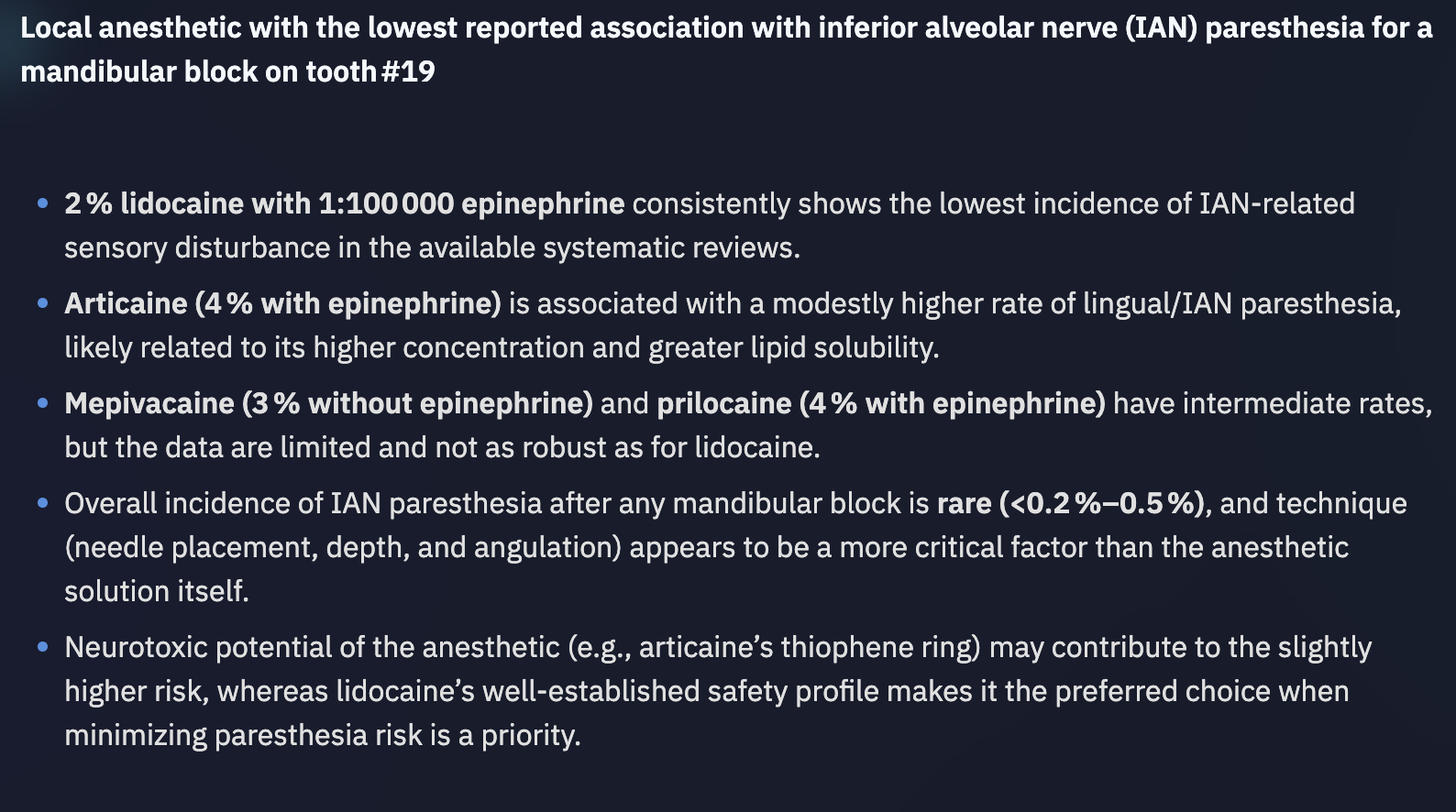
Recording this verification in the chart—"Anesthetic selection reviewed via Isaac AI clinical intelligence system: carbocaine chosen to minimize paresthesia risk"—transforms instinct into defensible documentation.
"If you're not using this tool, and it's readily available, that's a problem," Dr. Feit states. "My personal opinion is that AI clinical decision support is the standard of care now."
AI in Dentistry as Your Instant Second Opinion
Dr. Feit remembers spending 30 hours in the library preparing research presentations during his prosthodontic residency. His brother, years later, could do the same work in an hour with computers.
"Now with Isaac, maybe it's three minutes," he says. "There is no excuse not to use it. You can't tell me you don't have the time."
But AI clinical decision support isn't replacing clinical judgment—it's protecting it from the inevitable gaps that come with being human.
"Isaac is a built-in second opinion, and it's instantaneous," Dr. Feit explains. "It keeps you from setting yourself up for failure."
When AI Clinical Decision Support Strengthens Malpractice Prevention
Consider common high-risk scenarios where AI in dentistry provides rapid verification:
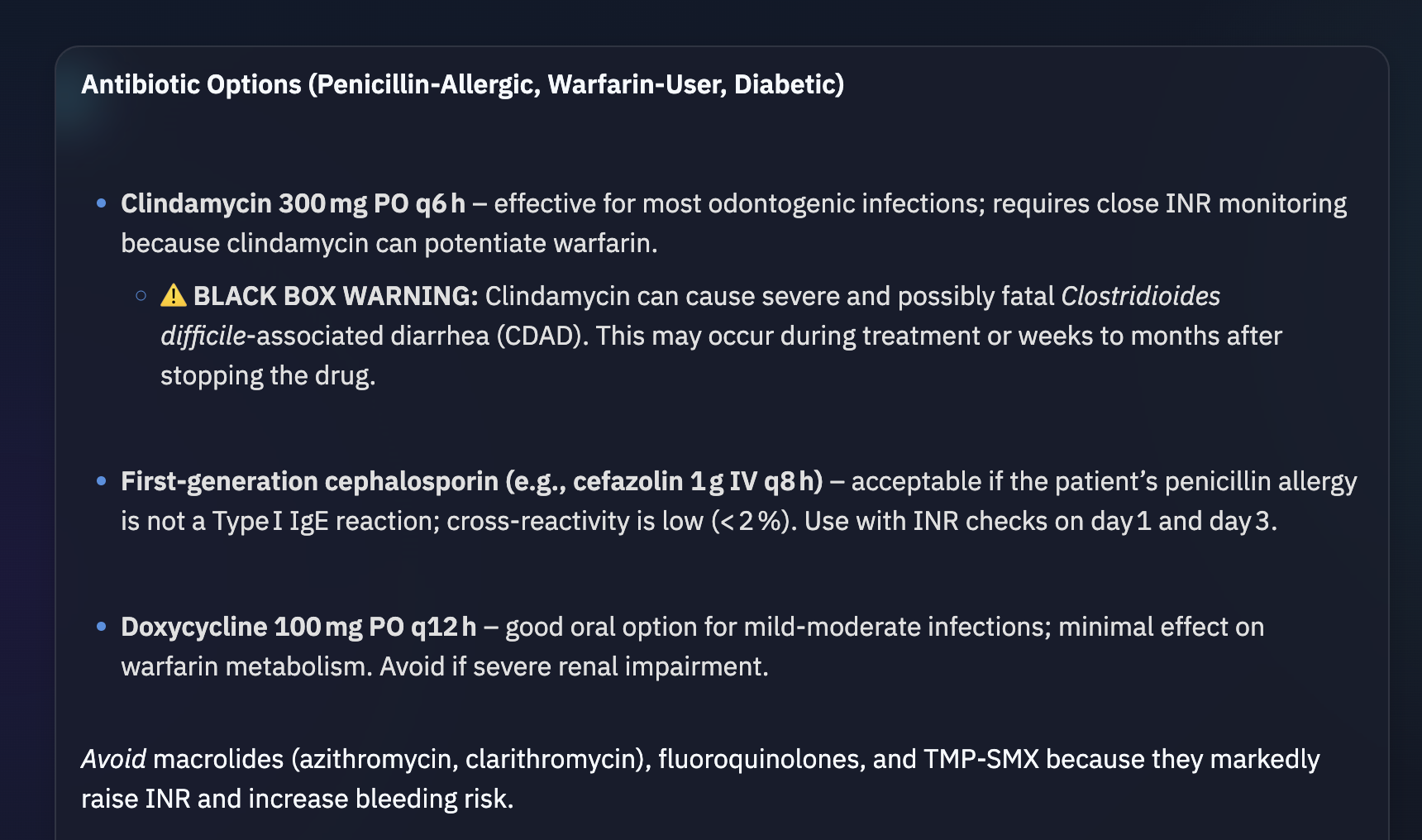
Complex Medical Histories:
Prompt: "For a diabetic patient on warfarin with a penicillin allergy, recommend safe antibiotic and analgesic options."
Snippet of Isaac's Response:
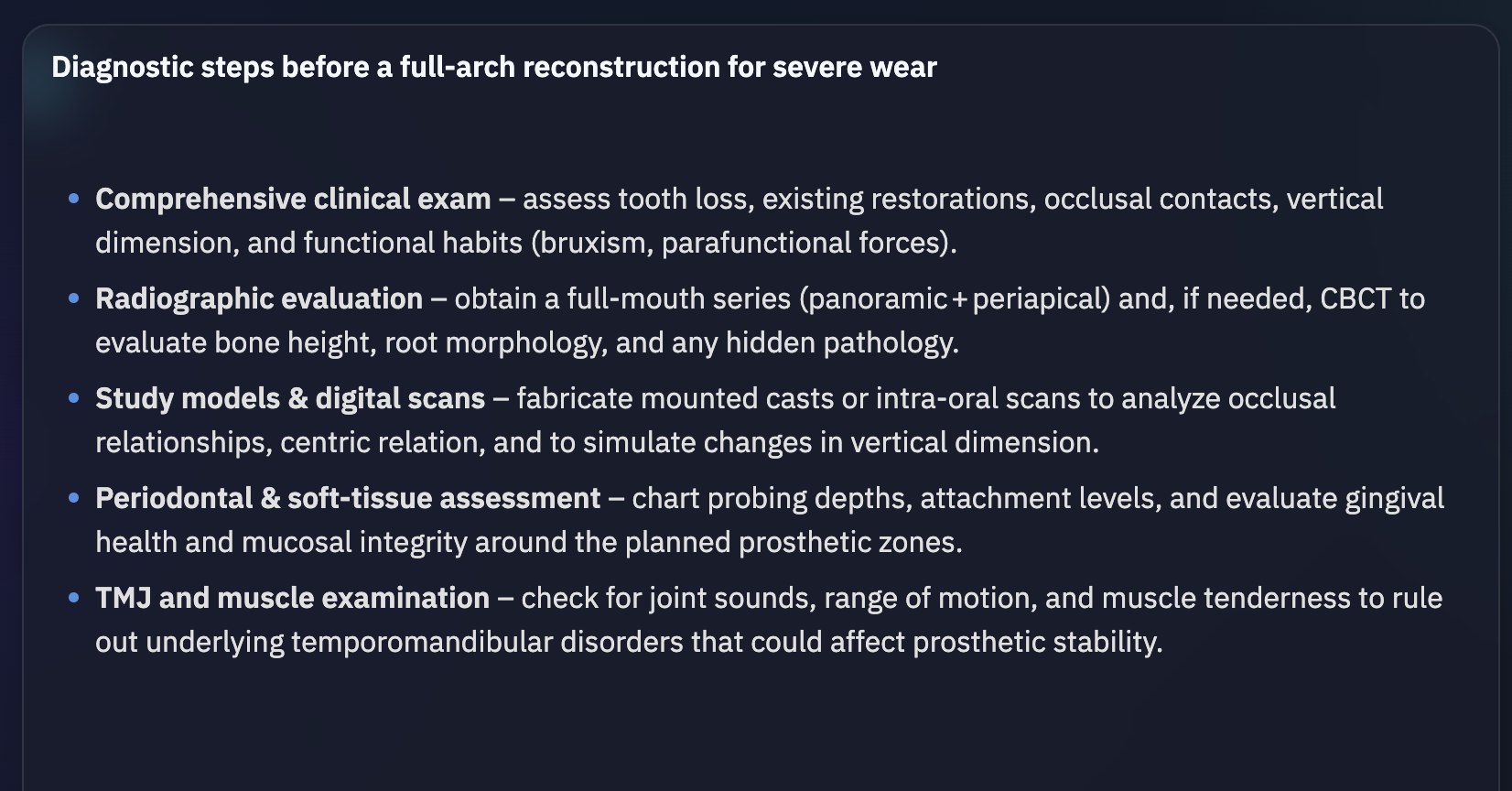
Treatment Planning Verification:
Prompt: "What diagnostic steps should precede full-arch reconstruction for severe wear?"
Snippet of Isaac's Response:
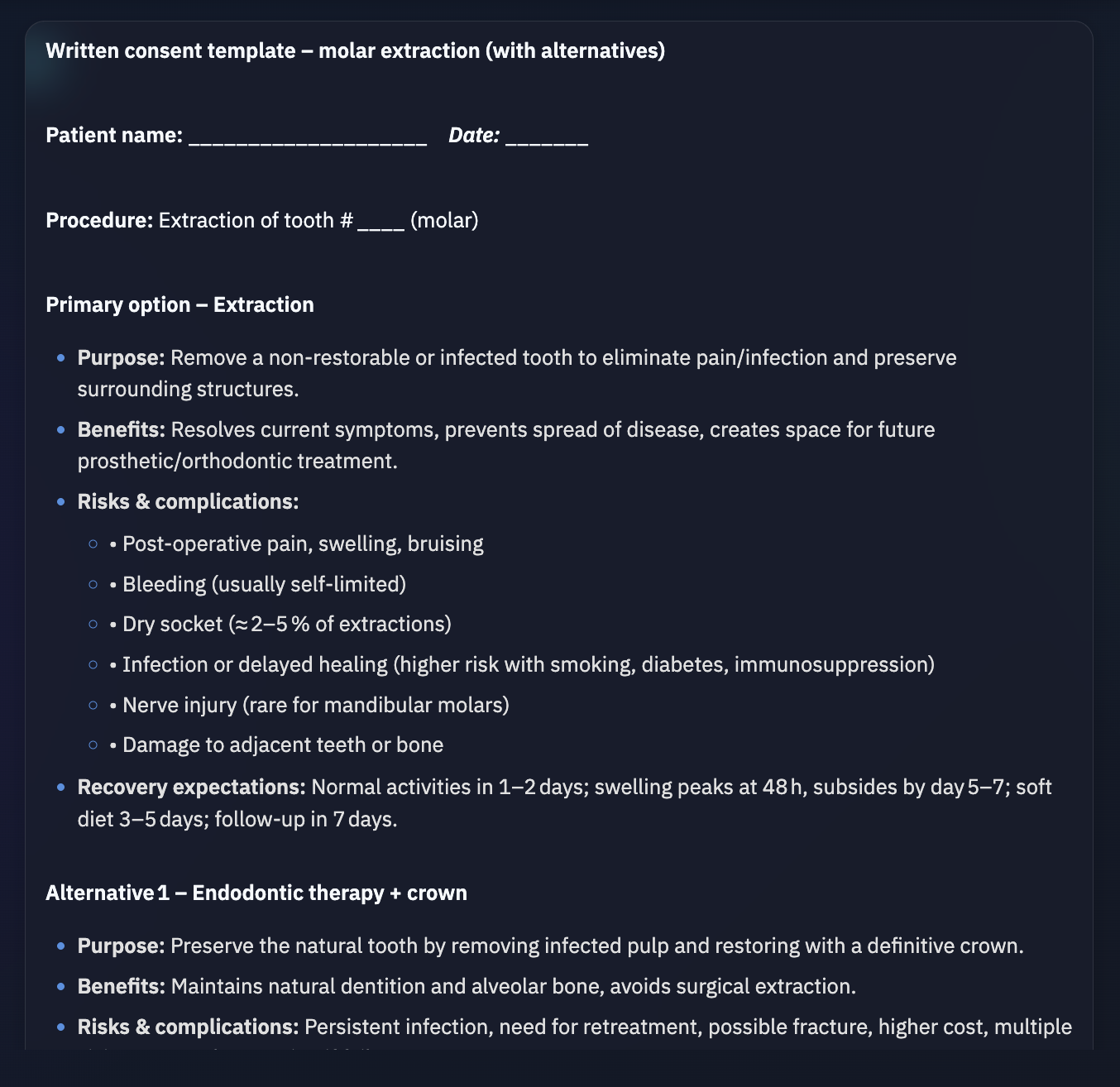
Consent Discussions:
Prompt: "Draft a consent discussion for molar extraction with three alternatives, including risks, benefits, and recovery expectations."
Snippet of Isaac's Response:
Each AI consultation becomes part of your defensible documentation: proof that you paused, verified, and chose thoughtfully rather than reflexively.
Defensible Documentation That Actually Protects You
"I've reviewed hundreds of dental malpractice cases," Dr. Feit says. "I've never seen a chart that was truly defensible when the note just said 'Extracted #19.'"
Incomplete notes remain the weakest link in malpractice risk management. No diagnosis. No consent record. No rationale. In legal review, that silence becomes damning.
Trust AI's built-in Scribe changes this entirely. It automatically captures clinical conversations and converts them into structured SOAP notes—complete with findings, patient questions, informed consent details, anesthesia selection, and post-operative instructions.
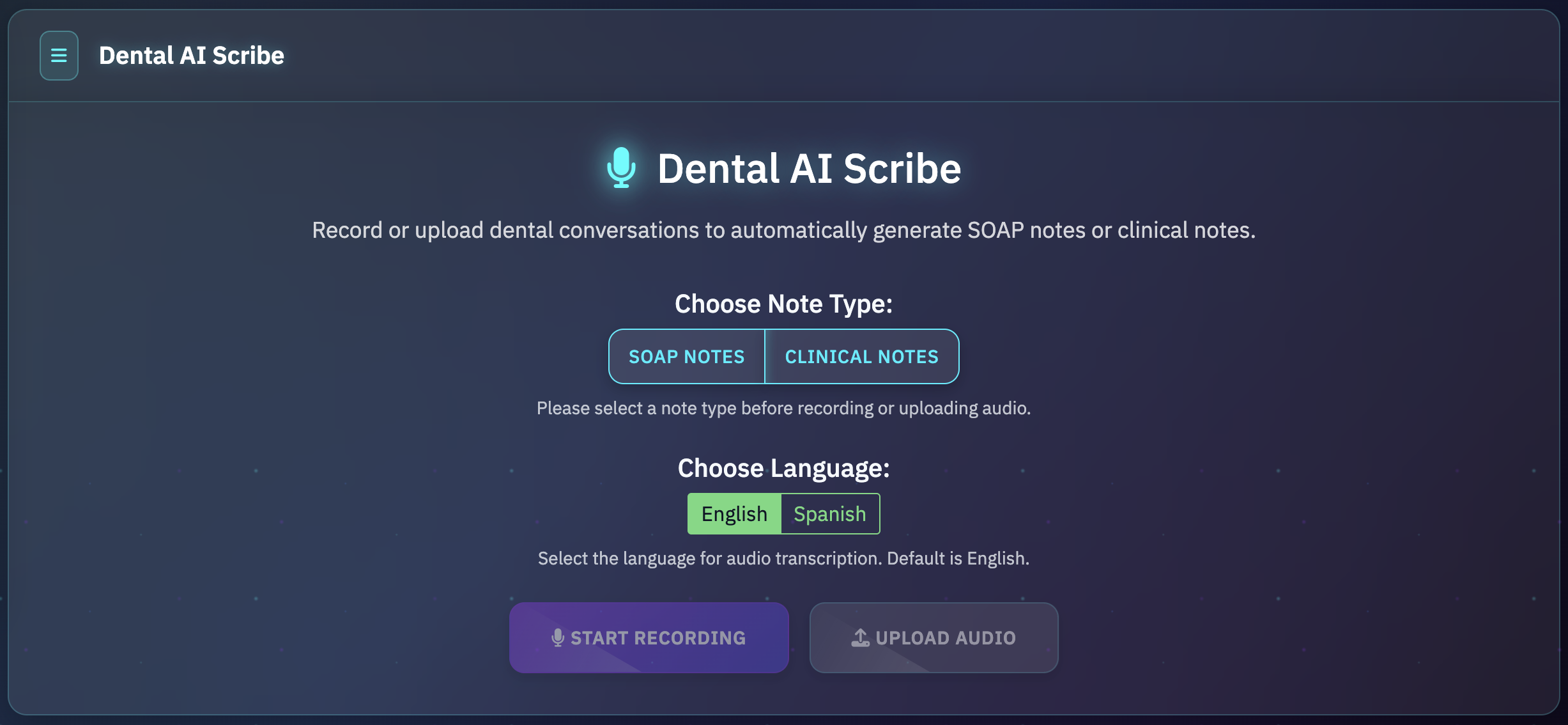
💡Try Trust AI Scribe Free
Log into chat.trustdentistry.ai and start a conversation with Isaac, your clinical intelligence partner. The Scribe automatically structures your clinical notes or dental notes in real-time—no charge during beta.
What used to take 15 minutes at day's end now happens seamlessly during patient care. And when an attorney requests records three years later, your defensible documentation tells the complete story.
What AI Clinical Decision Support Can't Replace
"No algorithm can fix a practice with poor culture," Dr. Feit emphasizes. "AI in dentistry doesn't make bad clinicians good. It helps good clinicians be more consistent."
That distinction matters for dental malpractice prevention, both legally and ethically.
Isaac excels at verification and knowledge retrieval. But it can't replace the pattern recognition you've built examining hundreds of post-operative patients. When tissue feels different or a patient's vague description triggers your clinical intuition, that's when your experience matters most.
Think of Isaac as your most well-read colleague who's always available for a consult. You wouldn't follow a colleague's advice blindly—and the same applies here. The final decision and legal responsibility remain yours.
Where AI clinical decision support adds maximum value for malpractice risk management:
- Consistency under pressure when you're running behind schedule
- Knowledge gaps outside your daily scope
- Defensible documentation so nothing critical gets missed
- Communication precision for sensitive discussions
"Using AI doesn't create a higher standard of care," Dr. Feit clarifies. "What matters is that your decisions are defensible and your patients feel heard. Isaac makes it easier to meet that standard consistently—especially on the days when your schedule is packed and you're already thinking about the crown prep in the next operatory."
Human Interventions That Strengthen Dental Malpractice Prevention
The Eight-Second Call
"If you time it, the post-op call is eight seconds," Dr. Feit says. "'Hi, I was just thinking of you—how are you feeling?' That's it. The patient feels cared for, not forgotten."
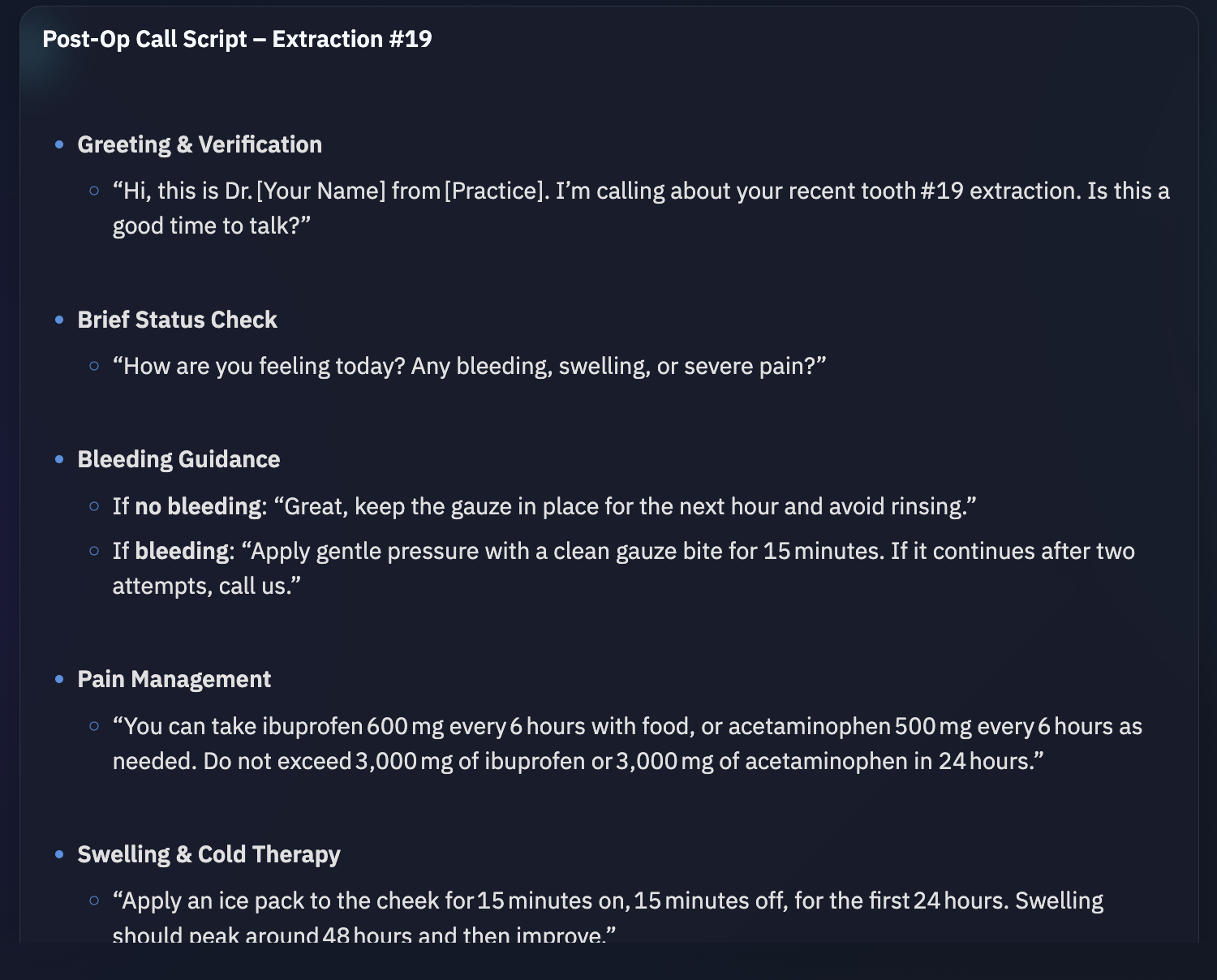
Isaac can generate the reminder and provide a script template:
Prompt: "Generate a short post-op call script and chart-note template for extraction #19."
Snippet of Isaac's Response:
But the call itself? That's all you. And it does more for dental malpractice prevention than any legal clause.
When Restitution Is the Right Malpractice Risk Management Strategy
"Sometimes the best outcome is to write a check, have them sign a release, and say, 'I see the future and you're not in it,'" Dr. Feit advises. "You're buying peace and quiet."
Most dentists resist. They think about overhead, lab bills, time invested. But Dr. Feit is pragmatic about malpractice risk management:
"While you're redoing that case with your back against the wall, you could be seeing two or three other patients who are easier, nicer people. And if you don't get it right the next time, you know it's going to litigation. What kind of pressure is that?"
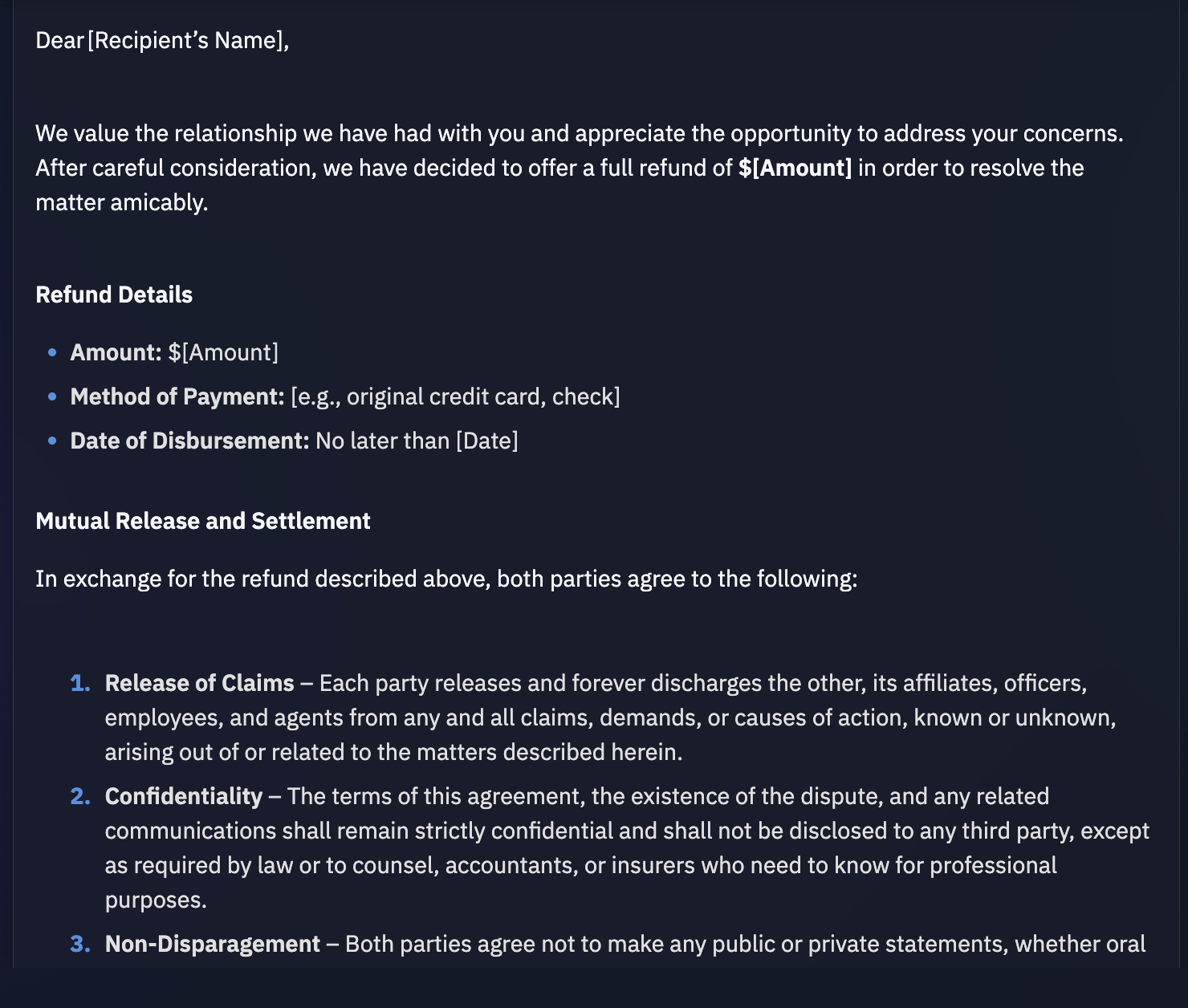
Isaac can help frame this communication professionally:
Prompt: "Write a respectful letter offering a refund and mutual release with confidentiality and non-disparagement language."
Snippet of Isaac's Response:
Handled early, this isn't a loss—it's dental malpractice prevention.
Language That Protects Professional Relationships
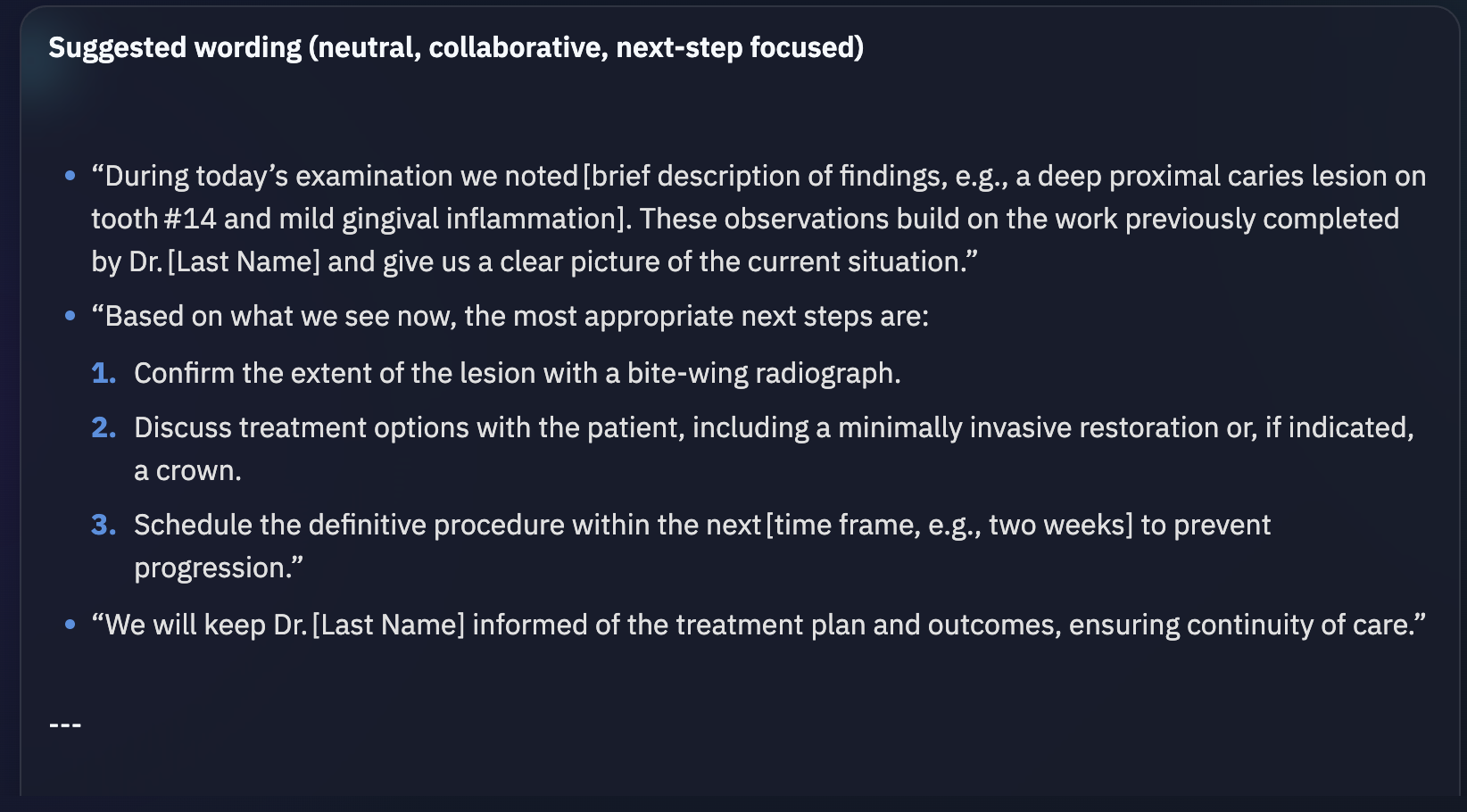
Dr. Feit often reminds clinicians that a single disparaging remark from a subsequent dentist can spark litigation. Isaac can train your team to speak with empathy and neutrality:
Prompt: "Provide wording to explain current findings without criticizing the previous dentist while focusing on next steps."
Snippet of Isaac's Response:
This protects both your patient relationships and your professional community—a key component of malpractice risk management.
Building an AI-Powered Malpractice Risk Management Routine
| Stage | Action | Example Isaac Prompt |
|---|---|---|
| Before treatment | Verify plan | "What diagnostic steps should precede full-arch reconstruction?" |
| During procedure | Document choices | "Summarize anesthetic type, dose, and rationale for chart note." |
| After procedure | Follow-up reminder | "Create a 24-hour post-op call note." |
| Practice level | Policy review | "List five essential elements of a refund-and-release agreement." |
Each prompt creates a small safeguard in your defensible documentation. Together, they form a consistent system of care that supports dental malpractice prevention.
The Lesson About Humanity from Henry Goldman
On Dr. Feit's first day of residency at Boston University, he sat down for lunch with a professor. Across the table was Henry Goldman—the dean whose name was on the building.
"Please call me Henry," Goldman insisted.
When the janitor rolled a garbage can down the hallway, Goldman called out: "Hey, Charlie, come on. Put that thing away and take a load off with me."
Goldman got up, bought Charlie a grape soda (grape, not Coke—proof this wasn't their first lunch together), waited in line to pay, and sat down with his friend.
Later, Dr. Feit's professor asked what he thought of lunch.
"If you kick me out right now, I've learned a lesson no one else will ever get," Feit replied. "You judge how big a person is by the way they treat their fellow people. And now I'm really good friends with the most powerful person in the school."
"Oh, you and Henry are good?" the professor asked.
"No," Feit said. "It's Charlie. Charlie's got the key to every door in the building."
That's the foundation of dental malpractice prevention.
When your patients feel like Charlie—truly seen, truly valued—they give you latitude when things go wrong. They want you to make it right. They'll let you.
AI in dentistry doesn't create that relationship. But Isaac protects it by offloading the mental weight of verification and creating defensible documentation, giving you the clarity to focus on what matters most: the human being in your chair.
The Future of AI Clinical Decision Support in Dentistry
Dr. Feit believes AI in dentistry will soon move from reactive to predictive—reminding clinicians to discuss risks, verify protocols, and call patients before problems arise.
"It's gonna schedule, optimize, help with treatment planning, order supplies," he predicts. "It's revolutionary for malpractice risk management."
But the core lesson remains: Be a human being first. Be heartfelt. Speak from the heart.
Technology doesn't replace humanity. It amplifies it.
As Dr. Feit learned from attorney Gerry Spence, who dropped his closing argument index cards in front of a murder trial jury: when you stop performing and start being real, "everything just flows."
"You want to mitigate dental malpractice?" Dr. Feit asks. "Be Gerry Spence. Be Henry Goldman. Be Charlie. Let the people decide what your title is. Prove yourself as a person first."
And let Isaac handle the clinical decision support and defensible documentation.
Ready to experience Isaac's clinical intelligence for dental malpractice prevention? Register for free access here.
Watch the full conversation about AI in dentistry and malpractice: Voices of Dental AI, Episode 5: Can AI Prevent Dental Malpractice? (Part 1 of 3) featuring Dr. Steven Feit and host Loren King.
Related Articles
Malpractice Prevention Should Be Designed Into the Practice

AI is Changing What Makes a Dental Practice Valuable