AI vs. Human Pattern Recognition in Clinical Dentistry: The 'Save or Extract' Decision
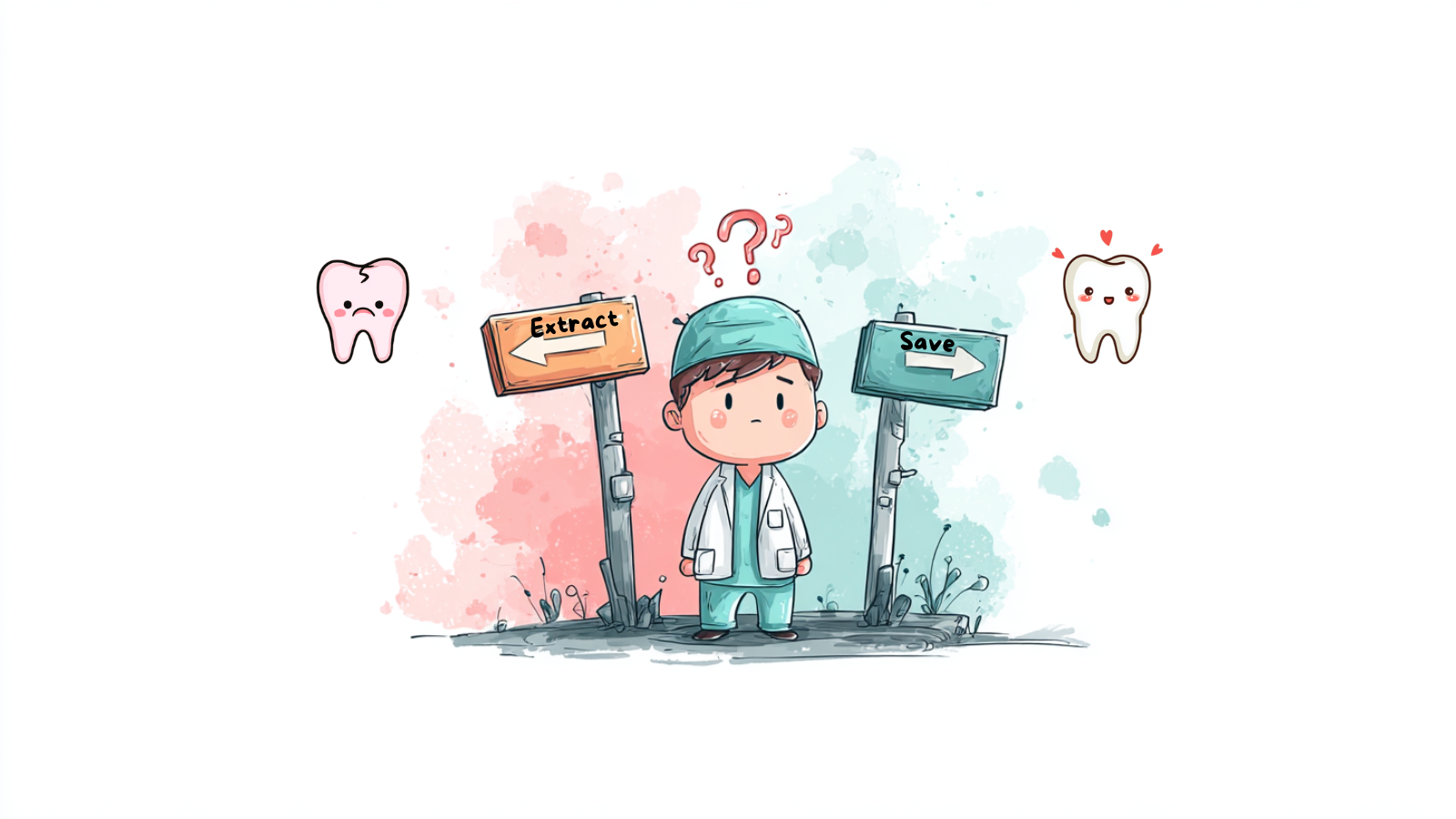
One of the most profound questions in clinical dentistry is also one of the oldest: When do we save a tooth, and when do we extract it? Every clinician has stood at this crossroads, feeling the weight of biology, biomechanics, psychology, and long-term consequences converge in a single moment.
For decades, dentistry has relied on one primary compass: human pattern recognition formed through repetition. Our instincts are shaped by every endo we have retreated, every hopeless molar we extracted too late, every patient we wished we could have helped differently. Experience matters. It shapes our judgment, our confidence, our intuition.
But here is a philosophical truth worth confronting: Human pattern recognition is powerful because it is earned. AI pattern recognition is powerful because it is evidence-based.
These two worlds are not competing. They are converging. And this convergence is reshaping how we diagnose and how we decide.
The Nature of Human Pattern Recognition
A dentist's intuition is built one repetition at a time. The more we see, the more we internalize. A radiolucency with a specific gradient during radiographic interpretation. A probing depth that feels "off" during periodontal assessment. A cracked tooth that whispers its prognosis before the patient even opens their mouth.
Our minds build mental shortcuts that are fast, efficient, and often accurate. But they also inherit limitations. We are shaped by what we have personally encountered, not by everything that exists. We carry cognitive biases. We get fatigued. Our pattern library, while impressive, is necessarily narrow.
That is not a criticism. It is a natural consequence of being human.
How AI Recognizes Patterns Differently
Artificial intelligence in dental diagnosis approaches the problem from the opposite direction. Where humans learn from repetition, AI learns from aggregate evidence drawn from millions of patterns across radiographs, CBCT datasets, periodontal findings, occlusal relationships, caries risks, medical interactions, and long-term outcomes.
It does not tire. It does not forget. It does not let the last difficult case cloud the next diagnosis.
AI processes dentistry not as a sequence of anecdotes but as a mathematical landscape. Every clinical finding has weight, relevance, and probability. Trust AI, a clinical intelligence platform, takes clinical inputs like probings, mobility, radiographs, vitality tests, patient history, and symptoms—synthesizing them into stratified risk assessment, diagnostic accuracy, and a consistent foundation that is objective and reproducible across clinicians and cases.
This is not replacement. This is reinforcement.
When to Extract vs. Save a Tooth: Evidence-Based Treatment Planning
Consider that single, emotionally charged question: Should we save this tooth? This endodontic treatment decision involves tooth prognosis assessment that goes far beyond a single radiograph.
The answer is rarely simple. Beneath the surface lie layers of nuance: remaining tooth structure, periodontal stability, crack propagation, occlusal forces, ferrule considerations, medical influences, risk tolerance, long-term planning, and restorative feasibility.
Traditionally, all of this lived inside the clinician's mind, filtered through personal experience. That is why two excellent dentists with the same information may give two completely different recommendations.
Trust AI fundamentally changes the starting point of that conversation through AI-powered dental treatment planning. It creates a shared diagnostic foundation using evidence-based dentistry principles—bringing consistency without removing individual judgment. The dentist still leads the decision. The patient still guides the direction. But neither is navigating the uncertainty alone.
AI does not standardize treatment plans. It standardizes the diagnostic truth behind them.
Clinical Intelligence: Combining Experience with Data-Driven Dentistry
There is a philosophical elegance here. Human intuition is invaluable because it carries empathy, context, and the lived reality of treating real people. Dental AI platforms are invaluable because they carry breadth, consistency, and a level of clinical pattern recognition that reaches far beyond human scale—analyzing data from CBCT analysis, periodontal charting, vitality testing, and comprehensive patient histories simultaneously.
Experience is depth. AI is breadth. Dentistry needs both.
When you combine a clinician's wisdom with evidence that is deep, unbiased, and instantly accessible, you do not diminish the dentist. You elevate their clarity. You give them more signal and less noise. You give them the confidence that their decisions are anchored in reality and reinforced by data.
This is what Trust AI brings to the operatory.
The Future: AI Clinical Decision Support in Dental Practice
The question of whether to save a tooth or extract it will always involve biology, biomechanics, cost, psychology, and long-term planning. That will not change. But what can change—and what must change—is the foundation we build those decisions upon.
Experience will always matter. Evidence will matter just as much. Together, they offer a diagnostic precision that dentistry has never had before.
Trust AI's clinical intelligence platform is not here to take the place of the clinician. It is here to give every clinician the clarity, consistency, and confidence of specialist-level diagnostic insights—delivered instantly, supported by evidence, and integrated seamlessly into dental practice workflow.
This is the new philosophy of dentistry:
- ✦Experience guided by intuition.
- ✦Intuition strengthened by evidence.
- ✦Evidence delivered by AI.
And it is going to reshape the future of care forever.
As AI in clinical dentistry continues to evolve, the practices that embrace clinical decision support tools will lead the profession forward. Whether you're evaluating hopeless tooth criteria, planning complex endodontic retreatments, or assessing long-term prognosis, Trust AI provides the diagnostic accuracy and evidence-based insights that elevate clinical excellence.
Run your practice with clinical intelligence.
Isaac PracticeOS is here — powered by Isaac OneHealth Ultra, the leading clinical AI in dentistry.
Experience the system. Speak with the intelligence behind it.
About the Author
Dr. Divian Narendra Patel, DDS, BDS
Chief Clinical Officer, Co-Founder
Dr. Patel practices at San Ramon Dental Excellence in California, specializing in conservative, ethical dentistry. His expertise spans invisible orthodontics, restorative, cosmetic, and implant dentistry, with a focus on delivering healthy, functional, and aesthetically pleasing results that prioritize patient well-being. He is the Chief Clinical Officer and co-founder of Trust AI.
Related Articles
Malpractice Prevention Should Be Designed Into the Practice

AI is Changing What Makes a Dental Practice Valuable