
FDA Updates Dental AI Regulations: What Dentists Need to Know About Treatment Recommendations
Recent FDA Clinical Decision Support Software guidance marks a significant shift in how AI-powered clinical decision-support tools can be used in dental practice. While the changes may seem subtle, they have meaningful implications for how AI assists with clinical reasoning without replacing professional judgment.
How Dental AI Regulation Has Changed
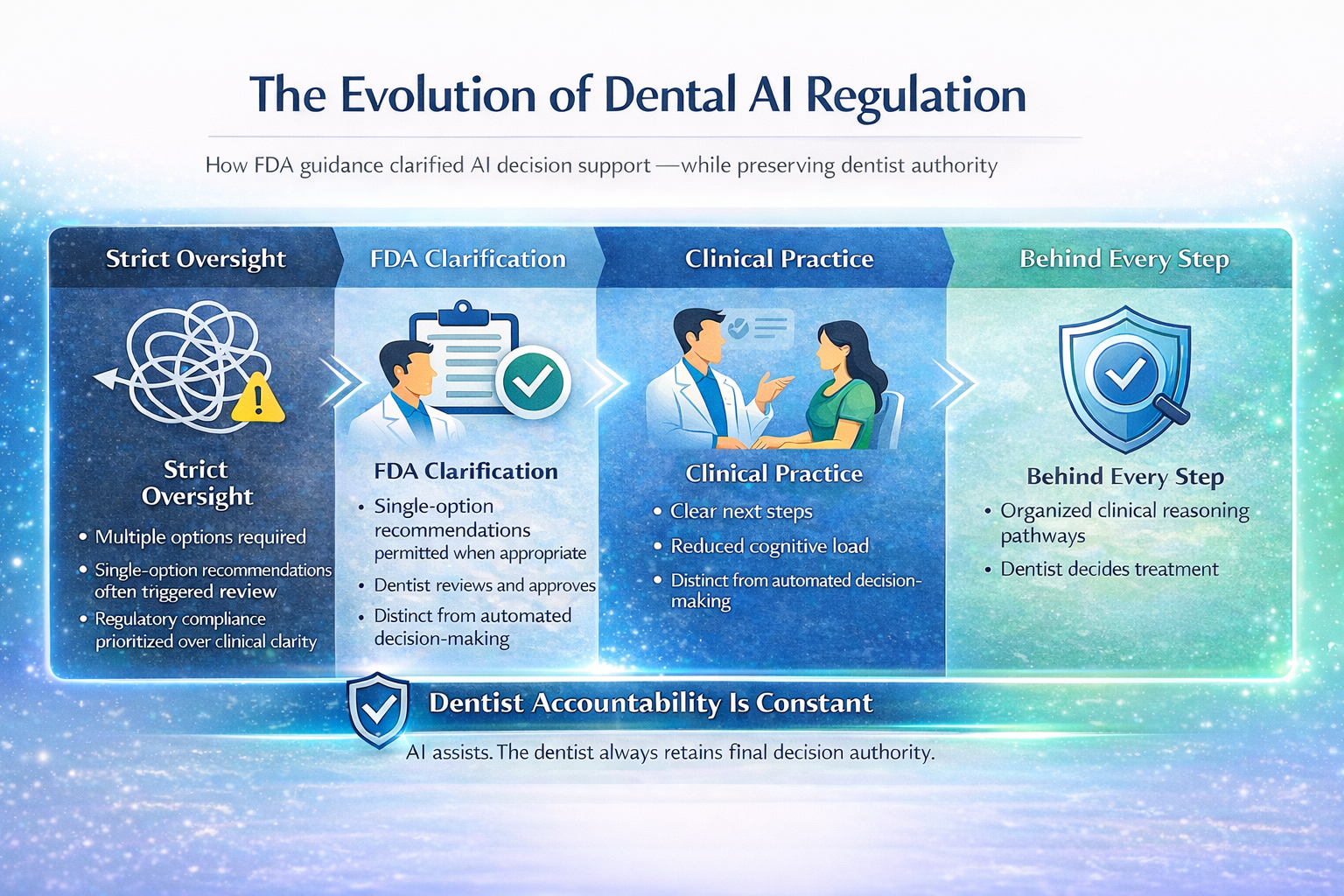
The Old Regulatory Landscape
Historically, dental AI software faced strict FDA oversight. When an AI system recommended a single treatment option—even one strongly supported by clinical consensus—it risked classification as a medical device requiring premarket review.
This led many developers to design systems that presented multiple treatment paths, even when those options weren't clinically equivalent. Regulatory compliance took priority over clinical practicality.
The FDA's New Position
The FDA now clarifies that when only one treatment option is clinically appropriate, and a licensed dentist reviews and approves the recommendation, premarket review may not be required. This aligns with the broader FDA guidance on wellness and CDS software.
This update acknowledges a fundamental reality: not all dental cases present equally valid treatment approaches. In many situations, the correct next step is clear, well-defined, and aligned with professional standards.
The dentist remains the final decision-maker.
What This Means for Daily Practice
Dentistry routinely involves scenarios where the appropriate action is evident based on established clinical criteria:
- •Periodontal cases meeting advanced disease criteria
- •Teeth fulfilling non-restorable criteria
- •Treatment plans requiring scaling and root planing as the necessary next step
- •Radiographic or clinical findings warranting specific recommendations
Under previous constraints, AI systems often diluted their guidance to stay compliant. The updated stance allows AI to reflect clinical clarity while maintaining explicit human oversight.
Understanding the Limitations
Importantly, the FDA doesn't define what constitutes a "clinically appropriate" recommendation. This deliberate omission places responsibility squarely on clinicians and developers.
Clear reasoning, transparent logic, and thorough case documentation remain essential. The regulatory shift permits decisiveness but not automation—AI assists with narrowing options without replacing professional judgment.
Trust AI's Approach: Three Treatment Pathways
Despite the FDA's allowance for single-option recommendations, Trust AI maintains a three-path framework:
- •Comprehensive – The biologically ideal approach for long-term stability and optimal outcomes
- •Conservative – A balanced option managing disease while preserving structure and limiting intervention
- •Minimal – A symptom-focused or temporizing approach guided by patient constraints or clinical risk
This structure mirrors how clinicians actually think, balancing biological idealism, patient realities, and risk tolerance. The system organizes clinical reasoning while the dentist selects the direction fitting the individual patient context.
Reducing Cognitive Load and Improving Patient Communication
This regulatory shift has practical implications beyond compliance—it affects how clinicians think, decide, and communicate under time pressure.
Dentistry is cognitively demanding. Many decisions happen amid interruptions, patient anxiety, and limited chairside time. When AI presents multiple non-equivalent options, dentists must mentally filter noise, explain unnecessary alternatives, and justify the obvious choice.
Clearer AI recommendations enable more focused patient conversations. Instead of navigating artificial choices, clinicians can explain why a particular step is indicated, its risks and benefits, and how it fits the broader treatment plan.
The Bottom Line
The FDA's updated guidance represents a maturation in regulatory thinking around dental AI. It recognizes that clinical clarity and human oversight can coexist without forcing artificial ambiguity into decision-support systems.
While AI tools may now offer more direct recommendations, accountability remains unchanged. The dentist retains authorship and responsibility for every clinical decision.
About the Author
Dr. Shervin Molayem is Chief Innovation Officer and Co-Founder of Trust AI. A periodontist and AI pioneer with 15 years of clinical experience, he filed the first patent in dental multimodal AI and introduced the first AI-powered periodontal probe (LuminX). He was among the first researchers globally to establish the Mouth-COVID connection and serves on the Innovation Committee at DAIA (Dental AI International Association). His work advances oral-systemic health through evidence-based technology.
Related Articles

Malpractice Prevention Should Be Designed Into the Practice

AI is Changing What Makes a Dental Practice Valuable