
Isaac OneHealth Ultra: What AI Native Intelligence Really Means for Dentistry
Most dental platforms now claim AI.
Notes get written. Insurance gets verified. Images get analyzed. Phones get answered. The features are real, and they save real time.
But there's a distinction most of these platforms miss:
Adding AI features to software does not make it AI native.
It isn't about how many AI tools you can bolt onto a platform. It's about where the intelligence lives.
When intelligence sits at the core of a system, it isn't confined to a single feature. It connects information across the practice, recognizes patterns, and notices when something doesn't look right, often before anyone asks.
That's what we built with Isaac OneHealth Ultra, which we'll simply call Isaac from here on.
Isaac started with Clinical Intelligence: reasoning across dentistry and medicine, scoring 100% on a 324-question USMLE benchmark.
But understanding the clinical side of dentistry wasn't enough.
For intelligence to sit at the core of a practice, it also had to understand the practice itself.
A Second Dimension of Intelligence
How does this practice operate? What's being missed, and what could happen next?
Answering that takes more than another AI feature.
It takes Operational Intelligence.
Isaac OneHealth Ultra brings two dimensions together:
Clinical Intelligence understands dentistry, medicine, and the patient.
Operational Intelligence understands the business behind the practice: its patterns, priorities, and opportunities.
Together, they form one intelligence that understands both sides of dentistry.
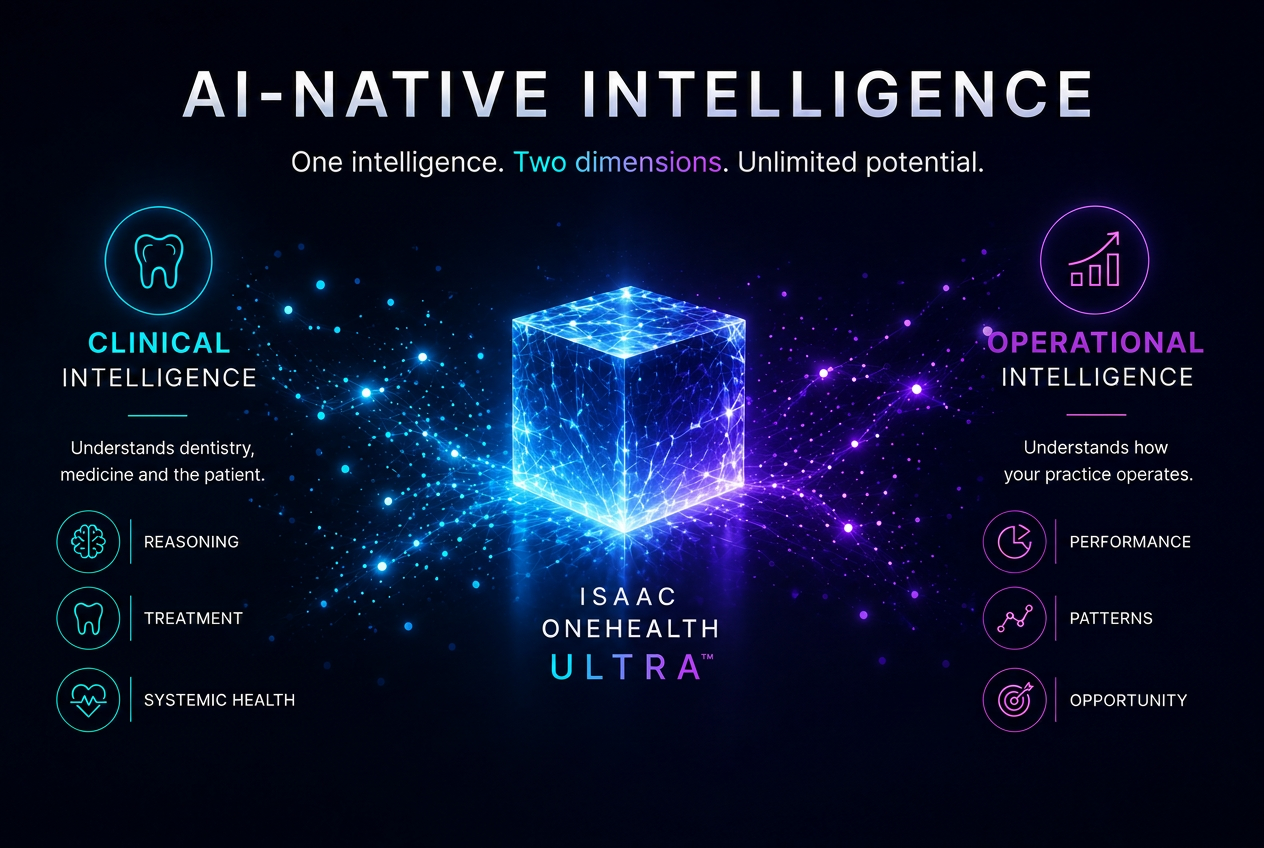
Scheduling, claims, insurance, patient communication, and clinical documentation may look like separate capabilities. With Isaac, they're connected by the same intelligence, so context from one part of the practice informs what happens in another.
The capabilities are what you see. The intelligence connecting them is what makes the system AI native.
What Does Operational Intelligence Actually Look Like?
The easiest way to understand Operational Intelligence is to see it in action.
Isaac is always watching the practice in the background, for gaps, risks, and opportunities, without waiting to be asked. On top of that constant baseline, a practice can direct Isaac to watch something specific, like weekly revenue gaps or chair utilization, and decide how often and when it runs.
The four cases below are real, from practices currently using Isaac PracticeOS, and only a glimpse of what Isaac can surface. Even so, they show it working at very different altitudes: across an entire practice, inside a single claim, and everywhere in between.
Names and identifying details have been changed for privacy. The findings have been preserved exactly as found.
Start With the Whole Practice
When a practice first migrates to Isaac PracticeOS, one of the most revealing uses of Operational Intelligence happens right at the beginning.
Years of practice data come with the migration: treatment plans, patient histories, scheduling activity, cancellations, collections.
That information was always there. What was missing was intelligence looking across all of it at once.
For this case, we looked at data from a newly migrated practice. Isaac ran a Practice Performance Audit to establish a baseline: where revenue was being lost, what red flags existed, and where the most immediate recovery opportunities were.
What Isaac found was substantial.
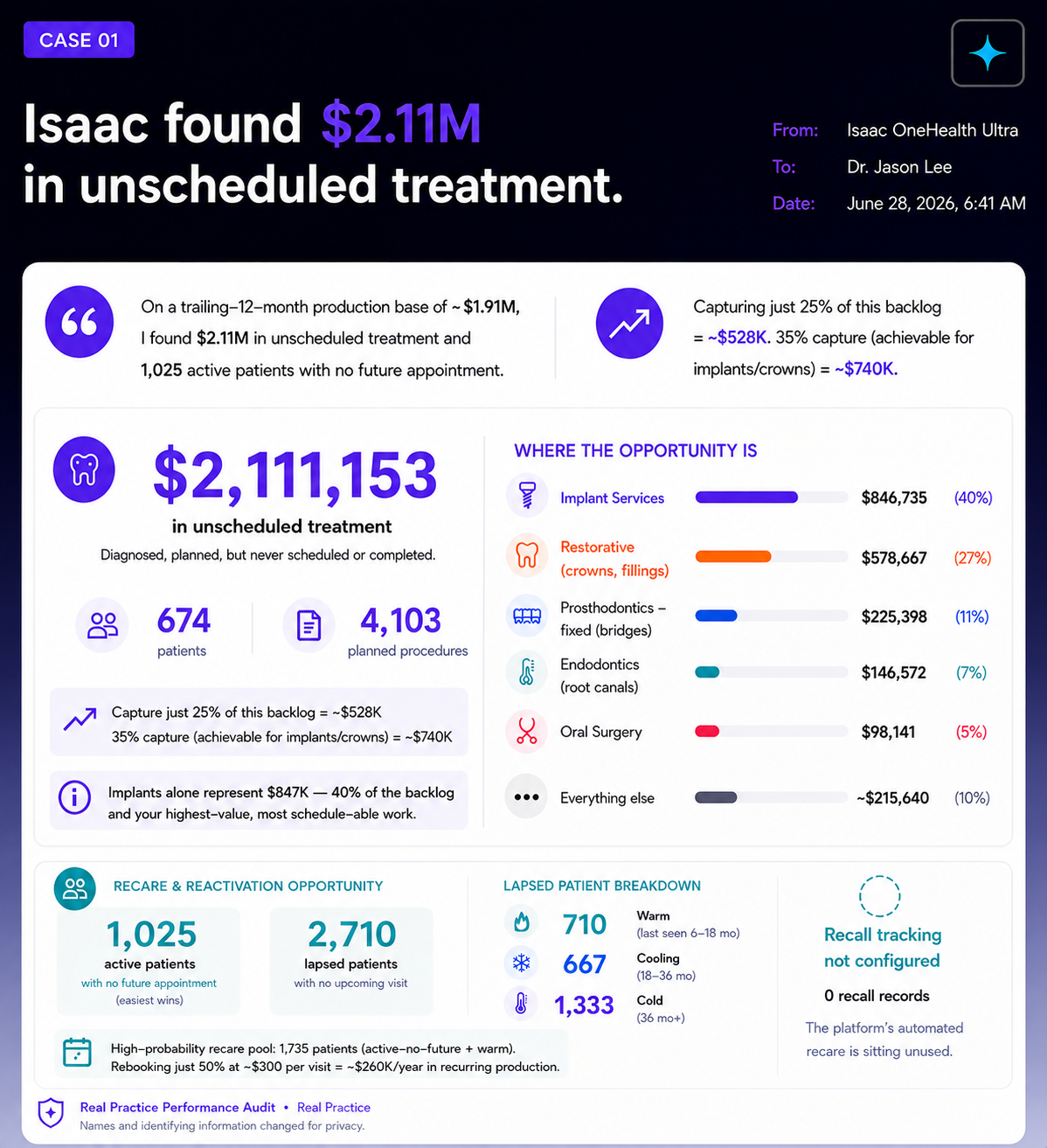
Isaac uncovered $2,111,153 in diagnosed and planned treatment that had never been scheduled or completed, spanning 674 patients and 4,103 procedures. Implant services alone accounted for $846,735.
It also found 1,025 active patients with no future appointment, another 2,710 lapsed patients with no upcoming visit, and recall tracking that had never been configured.
But identifying the gaps was only the beginning. Isaac calculated that capturing just 25% of the unscheduled treatment backlog represented approximately $528,000 in potential production.
For a practice migrating from a legacy system, this kind of visibility is often happening for the first time. Years of lost follow-up and unscheduled treatment finally become visible, and actionable.
A one-time audit finds the backlog. What keeps it from returning is Isaac continuing to watch after the migration is done.
The goal is not to find another $2.11 million backlog. It is to prevent one from accumulating again.
From the Whole Practice to a Single Claim
Operational Intelligence doesn't stop at understanding the practice as a whole. It also works at the level of a single claim, before that claim ever reaches a payer.
In one case, a $6,680.02 bridge preauthorization was ready to move forward. Isaac paused the submission after identifying three concerns across the patient's clinical history, imaging, and proposed treatment.
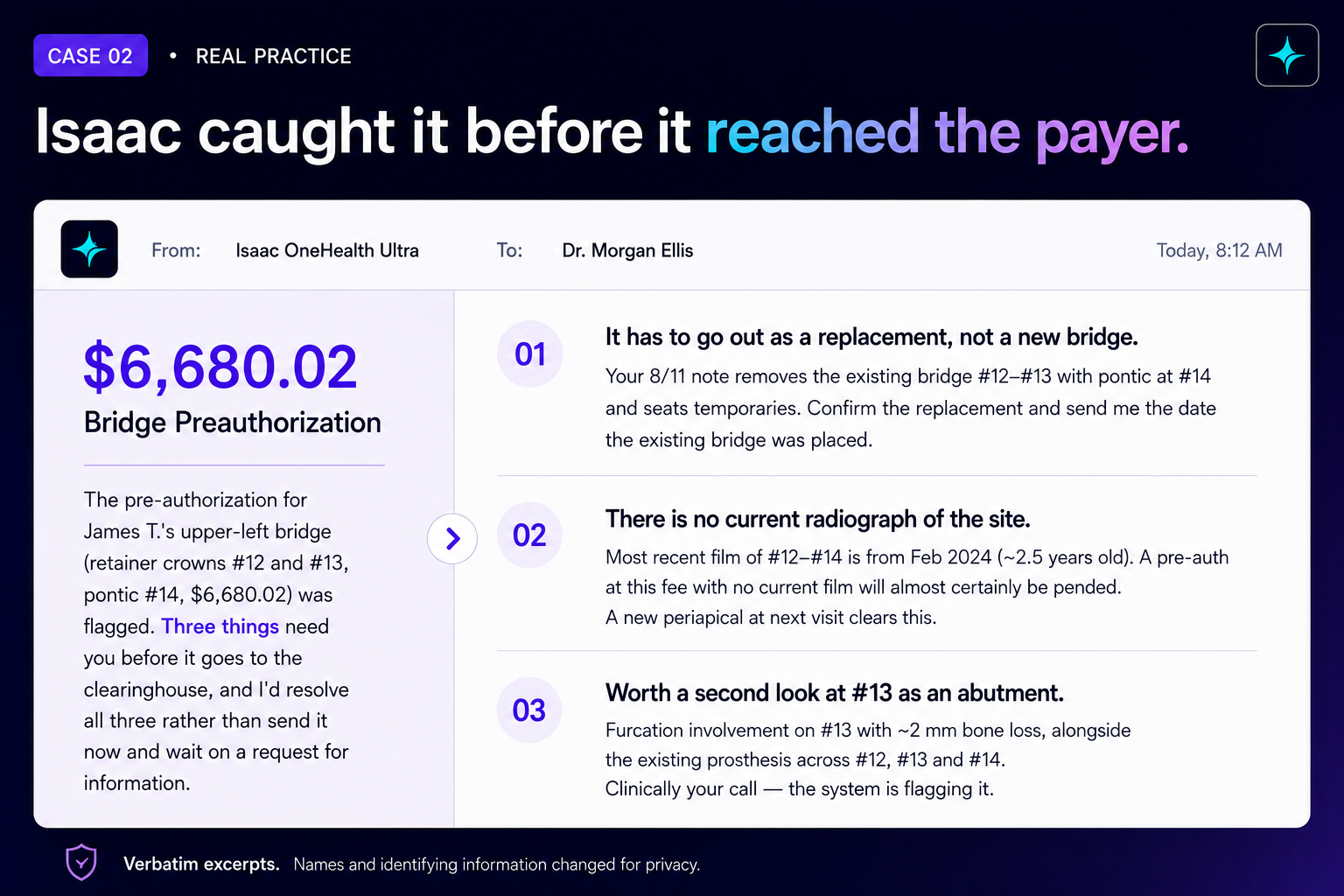
This is where Clinical Intelligence and Operational Intelligence come together. Isaac understood what had been done before, what the imaging showed, what was being proposed, and why the case deserved another look.
Isaac can catch the error, flag the missing film, question the coding. What it doesn't do is make the clinical call. That stays with the dentist.
"Clinically your call."
Four Claims. Four Different Problems.
In one practice review, Isaac flagged four claims worth $3,196, $809, $947, and $198, before they reached the RCM Hub. No two had the same problem: a missing radiograph, a date mismatch, an unconfirmed procedure, an eligibility issue.
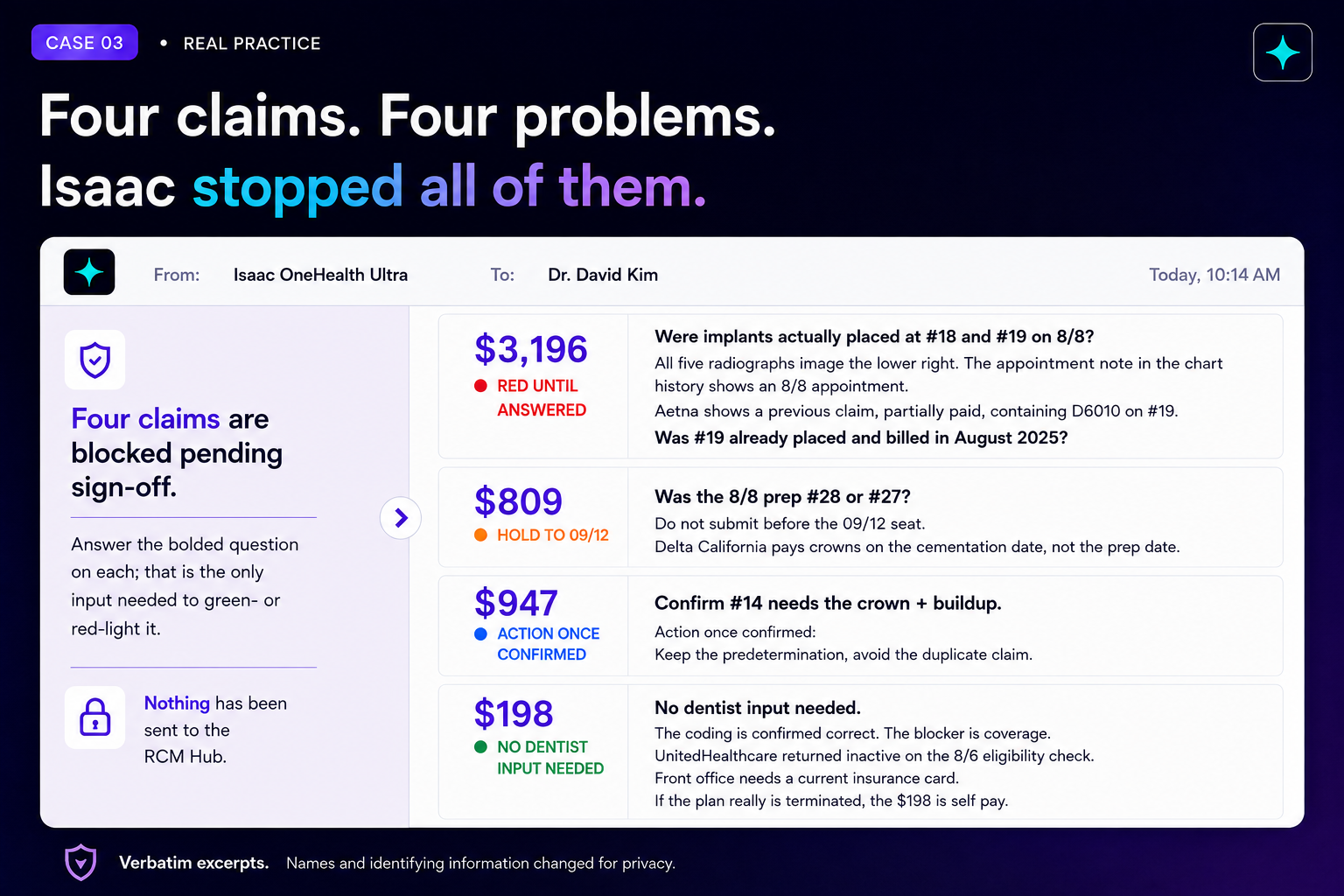
Four different failure types, caught in a single pass. That range is the real claim here: not just fewer denials, but the range of problems Operational Intelligence can hold in view at once.
Traditional software can validate fields and enforce rules.
Operational Intelligence goes further, looking at the context behind them and asking: Does this actually make sense?
The Problem Was Never the Cancellations.
Operational Intelligence looks past any single patient, claim, or transaction, watching for patterns across the whole practice.
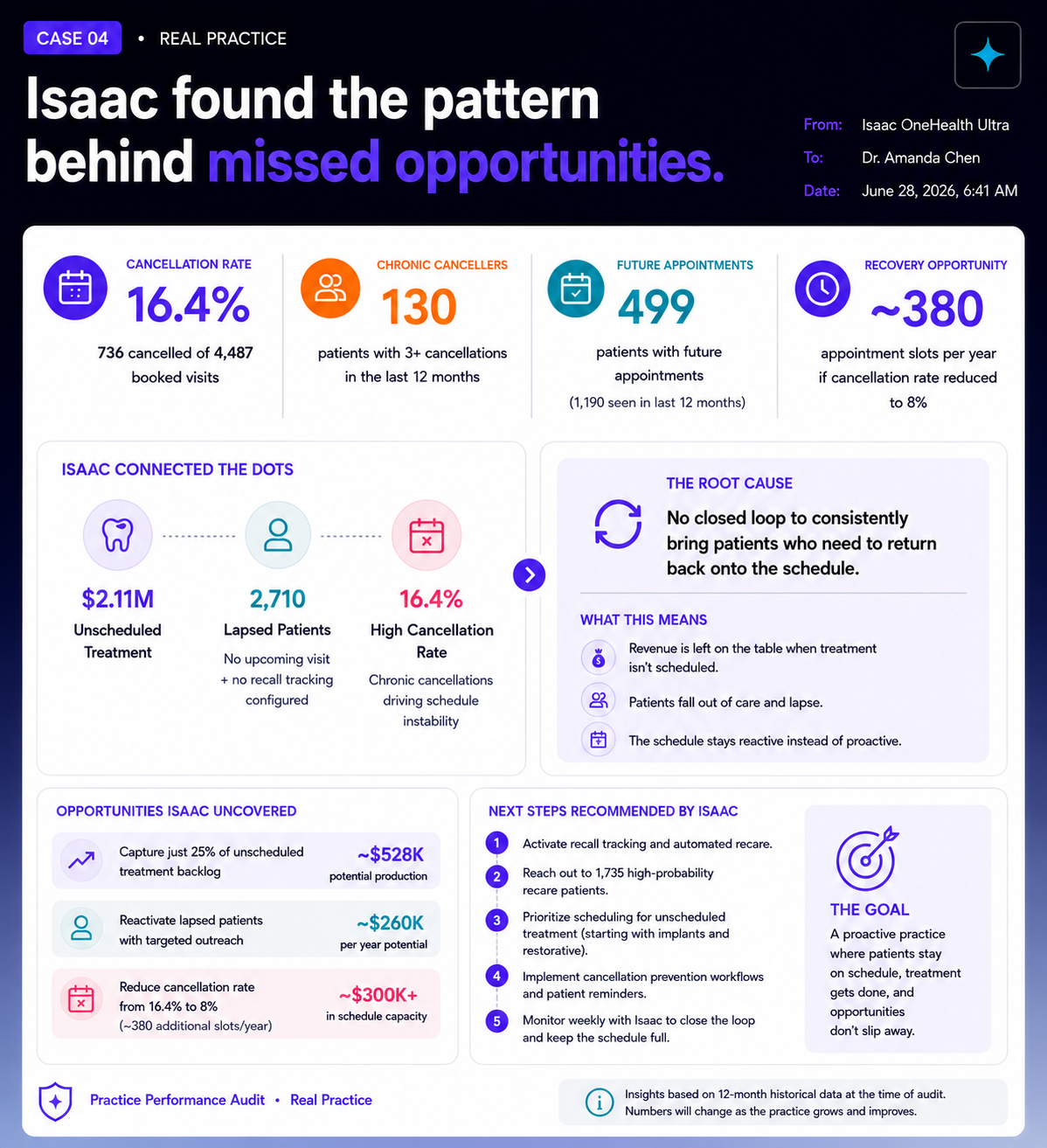
In this audit, Isaac found a 16.4% cancellation rate, identified 130 chronic cancellation patients, and calculated that reducing cancellations to 8% could free approximately 380 appointment slots per year. At the same time, only 499 patients had future appointments despite 1,190 having been seen in the previous year.
But the individual numbers were only part of the story. Isaac connected unscheduled treatment, recare gaps, and cancellations to a common operational problem: there was no closed loop consistently bringing patients who needed to return back onto the schedule.
Isaac didn't stop at the diagnosis. It laid out the fix: activate recall tracking, reach back out to the highest-probability patients first, and monitor weekly so the loop stays closed.
That is the difference between reporting what happened and understanding what the numbers are telling you about your practice.
See It in Your Practice
These four cases are a glimpse, not the whole picture. Across practices using Isaac PracticeOS, what Isaac notices, connects, and brings forward has often gone beyond what we expected it to uncover.
That intelligence keeps getting more contextual. Every day, Isaac understands more about how a practice operates, its patterns, preferences, history, and patients, and uses that context to recognize what matters next.
The numbers in this article are a start. Understanding what they mean for your practice happens where Isaac lives: inside Isaac PracticeOS.
See Isaac PracticeOS in action and discover what Isaac OneHealth Ultra could uncover in your practice.
Related Articles
Malpractice Prevention Should Be Designed Into the Practice
AI is Changing What Makes a Dental Practice Valuable