Lip Melanoma Misdiagnosed as Herpes: Diagnostic Blind Spots and the Role of AI in Early Detection
Clinical experience is one of the most powerful tools in healthcare. Years of training sharpen pattern recognition, refine intuition, and allow clinicians to move efficiently through complex decisions. But experience has a quieter side effect: it can make certain diagnoses feel too familiar. When that happens, vigilance can quietly erode into habit. This case is a reminder of how easily even sound clinical judgment can drift—and why pausing to reassess is not a weakness, but a discipline.
How a Lip Lesion Went Undiagnosed for Two Years
A 60-year-old male patient, a long-term smoker, was referred for what appeared to be a routine dental implant consultation. The referral raised no red flags. But during the clinical examination, a lesion was noted on the lower lip. The patient explained that it had been appearing and resolving intermittently for nearly two years. During that time, he had been seen by both a dentist and a physician. Because the lesion fluctuated in appearance, it had been diagnosed as herpes simplex and managed conservatively. No biopsy was performed.
Over time, the lesion did not resolve. Instead, it slowly increased in size. The patient became increasingly self-conscious, eventually wearing a mask in public to conceal it. What had initially seemed minor had quietly crossed a critical threshold.
Anchoring Bias in Clinical Diagnosis: When Experience Misleads
On closer clinical assessment, the lesion's characteristics no longer aligned with a benign viral condition. Its persistence, location, and the patient's risk profile prompted an urgent referral for biopsy. Histopathological analysis confirmed the diagnosis: lip melanoma—a rare but aggressive malignancy.
The diagnosis prompted smoking cessation. The lesion was excised and reconstructed successfully, meaningfully changing the trajectory of the patient's outcome.
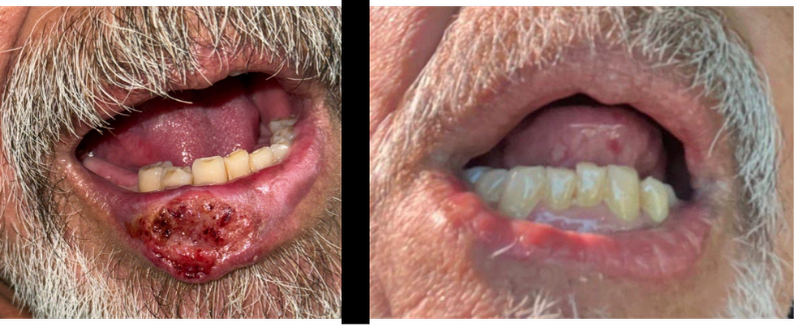
Figure 1. Clinical presentation of the lip lesion at initial examination (left) and postoperative appearance after surgical excision and reconstructive treatment (right).
The head and neck surgeon later noted that a further diagnostic delay of six to twelve months could have significantly worsened the prognosis.
This case illustrates a well-documented cognitive phenomenon: anchoring bias. Once an initial diagnosis is made—especially a common, seemingly low-risk one—it can unconsciously anchor all subsequent clinical reasoning. Even as features evolve, the original label persists. Anchoring bias does not spare experienced clinicians. In fact, familiarity can strengthen it.
How AI-Assisted Image Analysis Could Detect Oral Cancer Earlier
AI cannot diagnose cancer. Histopathology remains the gold standard. But AI can intervene earlier, at precisely the point where human cognition is most vulnerable to bias.
In dermatology and oral medicine, AI-based image analysis systems have demonstrated strong performance in identifying atypical or suspicious lesions, often matching or exceeding expert-level sensitivity when trained on high-quality, diverse datasets. In this case, AI would not have provided a definitive diagnosis—but it would have flagged the lesion as atypical and prompted further investigation. That single signal could have shifted the clinical trajectory: prompting earlier biopsy, interrupting diagnostic inertia, and shortening the time to definitive care.
AI's value in this context lies in offering clinicians a second perspective unburdened by prior assumptions. It sees the lesion without the history, without the earlier label, and without the reassurance that familiarity brings.
The Limitations of AI in Melanoma Detection: Bias, Data, and Responsibility
AI is not immune to bias. Models trained predominantly on lighter skin tones, for example, may underperform in detecting melanoma across darker pigmentation. Dataset diversity, image quality, and clinical context all matter. AI systems must be developed and validated responsibly, with transparent awareness of their limitations.
But when integrated thoughtfully, AI functions as a clinical safety net—one that nudges the clinician to pause when a presentation does not fully support a benign narrative.
Why Early Detection of Oral Melanoma Depends on Clinical Doubt
This case raises uncomfortable but necessary questions. How many serious conditions closely resemble common, low-risk diagnoses in their early stages? How often does familiarity delay escalation? And how many patients live with evolving disease because a presentation looked like something seen every day?
Early detection saves lives. Early doubt often makes detection possible. What matters most is cultivating moments of genuine reflection, and embracing tools that encourage us to look again when something does not quite fit—to stay curious rather than comfortable.
In that sense, AI's greatest clinical contribution may be its ability to create space for doubt. And in doing so, to protect the patient when familiarity begins to feel reassuring in all the wrong ways.
In this case, human clinical judgment ultimately changed the patient's outcome. With AI integrated earlier into the diagnostic pathway, that judgment might have been supported—and exercised—much sooner.
About the Author
Dr. Shervin Molayem is Chief Innovation Officer and Co-Founder of Trust AI. A periodontist and AI pioneer with 15 years of clinical experience, he filed the first patent in dental multimodal AI and introduced the first AI-powered periodontal probe (LuminX). He was among the first researchers globally to establish the Mouth-COVID connection and serves on the Innovation Committee at DAIA (Dental AI International Association). His work advances oral-systemic health through evidence-based technology.
Related Articles
Malpractice Prevention Should Be Designed Into the Practice

AI is Changing What Makes a Dental Practice Valuable