
The Most Important Skill in the Age of AI
I have been thinking a lot lately about what skills will be most valuable over the next decade.
Experience, expertise, communication, leadership, and technical ability will always be important. But I believe another skill is quickly moving toward the top of the list:
The ability to learn quickly and put what we learn into practice.
I have started thinking of this as learning velocity. How quickly can you recognize that something has changed, understand what is now possible, and incorporate it into the way you work?
In the age of AI, I think that ability is going to become a major competitive advantage.
Technology is now advancing faster than our traditional learning cycles. Look at what has happened with AI over just the past couple of years. ChatGPT changed how millions of people interacted with AI. Claude introduced different capabilities and workflows. New models seem to arrive every few months. Agents, integrations, voice, deep research, coding tools, image generation, and new capabilities are being added constantly.
I see this in my own use of AI. Just when I feel like I have figured out how to get the most out of an AI model, another feature or agent comes out that changes what I can do. A workflow that took ten steps six months ago may now take two, so I find myself constantly relearning how I work. And I don't think this pace is going to slow down anytime soon.
The Productivity Paradox
I recently came across a graphic from the Digital Education Council that describes something called "The Productivity Paradox." It caught my attention because it does a good job of explaining what I think many people and organizations are experiencing right now with AI.
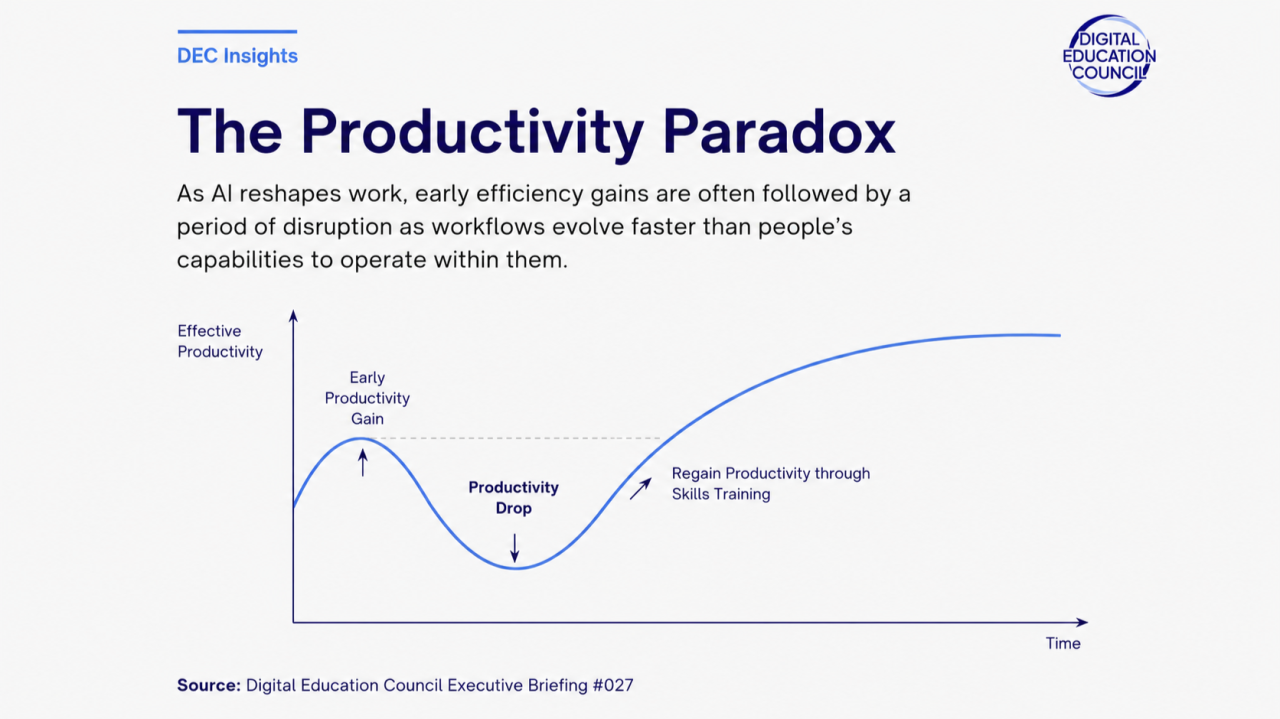
When a powerful new technology is introduced, productivity can initially improve. People find the obvious uses and get some quick wins. But as the technology continues advancing and workflows begin changing, the people using it have to catch up.
Old habits do not always fit the new tools very well, and people have not yet learned how to take advantage of all the new capabilities. Productivity can actually decline during this period.
As people learn the technology, rethink their workflows, and develop new skills around it, productivity begins climbing again. Eventually, it can move well beyond where it started.
I think this curve describes where we are with AI better than most explanations I have seen.
The Tool Is Only Half of the Equation
We spend a lot of time talking about which AI model is best. Which one reasons better, which one is faster, or which one has the newest features.
One person might use AI occasionally to write an email or summarize something. Someone else may have learned how to use the same technology for research, analysis, planning, communication, automation, decision support, and many other parts of their work.
The difference comes down to how well each person understands what the technology can do and how quickly they incorporate those capabilities into the way they work.
That is why I think learning velocity may become more valuable than mastery of any one piece of software. The advantage may increasingly go to the person who can see something new, understand it quickly, test it, and put it to work.
Dentistry Is About to Experience the Same Curve
I think this is especially relevant to dentistry.
For decades, dental practices have operated around the traditional practice management system. As new technologies became available, we added them around that system.
Digital radiographs, CBCT, intraoral scanners, patient communication software, insurance verification, revenue cycle management, online scheduling, AI imaging, voice charting, and call systems have all become part of the modern dental office.
Each solved a problem, but each also gave the office another system to learn and another workflow to manage.
AI gives us an opportunity to rethink that structure. Instead of simply adding another tool, we can begin thinking about an AI-native operating system for the dental office.
This is where learning velocity becomes adoption velocity. It is one thing for an individual to learn how to use AI. It is another for an entire dental practice to change the way it operates around it.
Imagine being able to ask the system questions about the practice instead of navigating through multiple screens and reports. Workflows could be completed through conversation or voice. The clinical and administrative sides of the practice could work from the same intelligence, with AI understanding the schedule, patient history, insurance information, clinical records, treatment plans, payments, and the operational needs of the practice.
When the technology changes that much, the way the dental team interacts with software has to change with it.
There Will Be a Learning Curve
I think the dental technology industry sometimes creates the wrong expectation that new technology should require almost no learning. Of course software should be intuitive and good design is critical, but when technology fundamentally changes what is possible, some learning is inevitable.
Moving from paper charts to computers required learning. Moving from film to digital radiography required learning. Moving from analog impressions to intraoral scanning required learning.
Teams will need to understand how to interact with AI, what questions they can ask, which workflows can be automated, and which processes they have followed for years should be reconsidered.
For a period of time, some of this may actually feel slower. That is the dip in the productivity curve.
The mistake would be interpreting that temporary friction as evidence that the old way was better.
The Goal Is to Move Through the Dip Faster
This is where I think the conversation around AI adoption needs to change. Instead of asking whether there is going to be a learning curve, we should be asking:
How quickly can we get through it?
Because once a dental team learns how to operate differently, the benefits can start compounding. Repetitive tasks can be eliminated, unnecessary clicks reduced, software consolidated, information accessed faster, and administrative work automated. Team members can spend more of their time on work that actually requires human judgment and interaction.
As the underlying AI models improve, the system itself becomes more capable.
Historically, a practice learned a system and then used it essentially the same way for years. Now we are learning how to work in an environment where the technology itself is continuously improving.
That means learning is no longer something that happens only during implementation. It becomes part of how the practice operates.
The Practices That Adopt Fastest May Have the Biggest Advantage
Two dental practices could have access to exactly the same technology and get dramatically different results.
One practice may use AI as another feature inside its existing workflow. Another may start asking a much bigger question:
If we were designing the workflow today, knowing what AI can now do, would we still run the practice this way?
Many of our current workflows were created around limitations that technology used to have. As those limitations disappear, we should be willing to reconsider the processes built around them.
This is where adoption velocity becomes so important. The practices that can learn the technology, change their workflows, train their teams, and become comfortable operating differently will move through the productivity dip faster. Once they do, the difference between them and practices operating in the traditional way could become substantial.
Our Ability to Learn May Become the Advantage
For most of our careers, expertise accumulated relatively slowly. You learned a system, became good at it, and that knowledge remained useful for years.
AI changes that equation because the technology itself is evolving so quickly. For individuals, I believe learning velocity will become increasingly important. How quickly can we understand what is now possible and learn to use it?
For organizations, adoption velocity may be even more important. How quickly can an entire team take those capabilities and actually change the way it works?
We are seeing this firsthand at Trust AI as we transition dental practices to an AI-native practice operating system. Offices that have already moved through the initial learning curve are showing us what happens on the other side, as teams adapt their workflows and begin taking advantage of a fundamentally different way of operating a practice.
It's truly a beautiful thing we're witnessing.
About the Author
Dr. Shervin Molayem is Chief Innovation Officer and Co-Founder of Trust AI. A periodontist and AI pioneer with 15 years of clinical experience, he filed the first patent in dental multimodal AI and introduced the first AI-powered periodontal probe (LuminX). He was among the first researchers globally to establish the Mouth-COVID connection and serves on the Innovation Committee at DAIA (Dental AI International Association). His work advances oral-systemic health through evidence-based technology.
Related Articles
Malpractice Prevention Should Be Designed Into the Practice

AI is Changing What Makes a Dental Practice Valuable